Making fresh bread or pizza at home is easier when a machine handles the repetitive mixing and kneading. The best dough kneading machines for small batches combine manageable bowl sizes with controlled kneading, fermentation, and timing features.
We compared 10 electric dough makers ranging from compact 3.7-quart models to larger 7.4-quart machines, focusing on capacity, controls, materials, versatility, and everyday usability.
Best 10 Dough Kneading Machines for Small Batches Picks for 2026
Best Accessory Bundle

- 5-liter stainless steel mixing basin
- 5–40 minute programmable timer
- Includes measuring tools and dumpling wrapper
Best For: Bakers wanting flexible capacity and included accessories
Best for Larger Household Batches
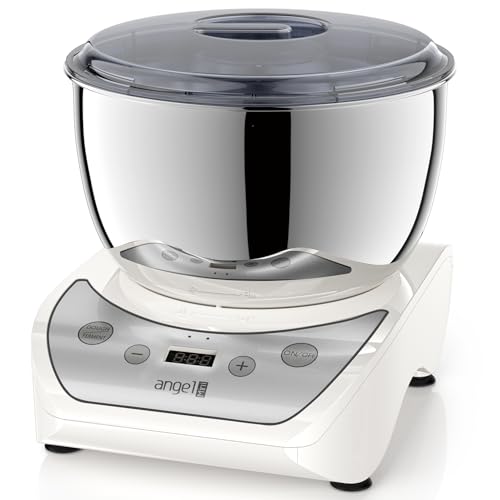
- Large 5.5-quart dough capacity
- 86–104°F constant-temperature fermentation
- 250W motor with touch controls
Best For: Families preparing multiple dough portions at once
Best Compact Low-Noise Option

- Handles approximately 198–1077g of dry flour
- 77–100°F thermostatic fermentation
- Stable suction-cup base and stainless steel bowl
Best For: Home bakers making compact, repeatable dough batches
Best Dough-Focused Pick

- Dough-specific kneading design
- Timed fermentation up to 100°F
- Up to 1.4 kg of dough
Best For: Home bakers prioritizing hands-free dough making
Best Compact Design

- Compact body for tight countertops
- Fermentation control up to 105 minutes
- Quiet belt-drive kneading system
Best For: Apartment kitchens and space-conscious bakers
Best for Controlled Kneading

- Supports 300–1,400g of dough
- Timed hand-kneading simulation
- Knob controls and suction-cup base
Best For: Bakers wanting stable, quiet, adjustable operation
Best with Built-In Scale
5.2QT Dough Mixer with Weighing

- Integrated precision scale
- Adjustable kneading and proofing timer
- Compact 5.2-quart capacity
Best For: Bakers wanting measured ingredients and programmable preparation
Best Seasonal-Fermentation Pick – Joydeem 3.7Qt Dough Maker
For shoppers comparing dough kneading machines for small batches, the Joydeem HMJ-A351 combines a compact 3.7-quart bowl with adjustable kneading and fermentation programs. Its seasonal temperature modes are especially useful when you want more consistent proofing throughout the year.
Best For: Home bakers making bread, pizza, pasta, dumplings, roti, or sourdough in controlled small-to-medium batches.
Pros:
- Handles flour weights from 200g to 1100g, with up to 900g recommended for fermented dough.
- Offers separate mixing, fermentation, and combined programs with adjustable times.
- Dual seasonal fermentation modes maintain approximately 35–45°C.
- 304 stainless steel bowl and blade, plus suction-cup feet for stability.
Cons:
- Fermented dough capacity is lower than the bowl’s maximum flour range.
- The motor operates intermittently and does not offer adjustable speeds.
- Its 3.7-quart capacity may be limiting for larger households.
The Joydeem stands out when fermentation control matters as much as kneading. It is a practical choice for frequent home baking, provided your typical dough quantities fit its recommended limits.
Best Accessory Bundle – 5L Electric Dough Maker
This 5-liter electric dough maker is worth considering among dough kneading machines for small batches if you also want room for occasional larger mixes. A timer, viewing lid, and included measuring accessories make it a straightforward option for routine kitchen use.
Best For: Bakers who want a versatile 5-liter machine with timed kneading and useful starter accessories.
Pros:
- Built-in timer allows mixing and kneading periods from 5 to 40 minutes.
- 200W motor runs at a stated 140–170 rpm and includes a fermentation function.
- 304 stainless steel basin and blade support repeated food-contact use.
- Includes a measuring cup, spoon, dumpling wrapper, and egg separator.
Cons:
- Its 75 dB listed noise level is higher than several compact alternatives.
- The 5-liter capacity may be more than needed for strictly small batches.
- The notes do not specify a temperature range for fermentation.
Choose this model if capacity flexibility and included tools are priorities. For a very quiet countertop machine or tightly controlled proofing temperatures, the available specifications are less reassuring.
Best for Larger Household Batches – Mini Angel 5.5QT Mixer
Although larger than many dough kneading machines for small batches, the Mini Angel 5.5-quart mixer can suit households that alternate between modest recipes and multiple loaves. It pairs a 250W motor with one-touch dough and fermentation controls.
Best For: Large families or gatherings that need to prepare several portions of bread, pizza, or pastry dough at once.
Pros:
- 5.5-quart capacity provides room for larger dough preparations.
- Constant-temperature fermentation operates from approximately 86–104°F.
- Touch controls support mixing, fermenting, or combined programs with adjustable timing.
- 304 stainless steel bowl and blade are designed for durability and easier cleaning.
Cons:
- Its larger capacity is less suited to shoppers seeking the smallest footprint.
- The listed noise level is not provided, so quietness is difficult to compare.
- The notes state that intermittent motor operation is normal.
The Mini Angel is the capacity-focused choice in this group. Its fermentation range and simple controls add convenience, but small-batch bakers should confirm that the 5.5-quart format fits their counter and typical recipes.
Best Compact Low-Noise Option – Bear 3.7-Quart Dough Maker
The Bear HMJ-A35M1 is a compact option among dough kneading machines for small batches, with a 3.7-quart bowl, intermittent kneading motion, and thermostatic fermentation. Its suction-cup feet are intended to reduce movement and operating noise on the counter.
Best For: Home bakers who typically make smaller portions of bread, pizza, roti, dumplings, or sourdough.
Pros:
- Supports dry flour weights from about 198g to 1077g.
- Adjustable mixing time reaches 40 minutes, while fermentation can reach 120 minutes.
- Constant-temperature fermentation ranges from approximately 77–100°F.
- 304 stainless steel bowl and blade, with suction-cup feet for stability.
Cons:
- The 120W motor is less powerful on paper than the 200W and 250W alternatives.
- There is only one speed and no speed adjustment.
- The conical design is compact but still requires a roughly 12.4-inch-deep footprint.
Bear’s model is a sensible fit for regular household batches where compact handling and fermentation are more important than maximum motor power. Its stated flour range gives small-batch bakers useful flexibility.
Best Dough-Focused Pick – 5.3QT Timer Dough Kneader
For shoppers comparing dough kneading machines for small batches, this model emphasizes hands-free kneading rather than general-purpose mixing. Its 5.3-quart stainless steel bowl, timer, and fermentation function suit home bakers making bread, pizza, pasta, or sourdough.
Best For: Home bakers who want straightforward, low-noise dough preparation with timed fermentation.
Pros:
- Designed specifically for dough and includes a removable S-shaped stainless steel blade.
- Timer and fermentation function can warm dough to 100°F (38°C).
- 5.3-quart 304 stainless steel bowl supports up to 1.4 kg of dough.
- Low-speed, high-torque motor is intended for quieter operation.
Cons:
- Its 150-watt motor and single dough-focused design may be less versatile than a traditional stand mixer.
- The 5.3-quart bowl may be more capacity than needed for very small dough batches.
This is a focused option for bakers who value consistent kneading and built-in proofing support. It is especially practical when dough preparation is the main task, though shoppers seeking multiple mixing speeds or broader attachments may prefer a conventional mixer.
Best Programmable Option – Joydeem 7.4Qt Dough Maker
Among dough kneading machines for small batches, the Joydeem stands out for programmable timing and intermittent kneading. Its stainless steel bucket and preset programs are useful for bakers who want automated mixing and proofing for bread, pizza, buns, or dumplings.
Best For: Families and batch-oriented bakers who want preset kneading and fermentation cycles.
Pros:
- Microcomputer controls support time presets and intelligent program selection.
- Can knead in about 15 minutes or knead and proof in about 45 minutes, with a drip alert.
- Intermittent kneading motion is designed to simulate manual dough making.
- Removable top cover and dishwasher-safe stainless steel bucket and blade simplify cleanup.
Cons:
- The 6.24-liter capacity is relatively large for shoppers making only small batches.
- It has one speed and no speed adjustment.
- Listed noise level is 70 dB, so it may not be the quietest choice.
The Joydeem is a strong fit when automation matters more than compact capacity. Its controls and preset cycles reduce hands-on work, but its larger bowl and single-speed operation may be less appealing for occasional small-batch bakers.
Best Compact Design – 5.3QT Fermenting Dough Mixer
This compact green dough mixer is a practical contender among dough kneading machines for small batches, combining a 5.3-quart bowl with a footprint suited to apartments and tight countertops. Independent Knead and Ferment controls make the basic workflow easy to follow.
Best For: Small-kitchen users who want a compact mixer with quiet operation and controlled fermentation.
Pros:
- Compact 10.67-by-9.72-by-9.69-inch body is designed for limited counter space.
- Fermentation time can be customized for up to 105 minutes.
- Full-copper DC motor and belt drive are intended to provide stable, quieter kneading.
- Includes a 304 stainless steel bowl, removable bowl, dough hook, and splash-proof lid.
Cons:
- The 5.3-quart capacity may still be larger than necessary for single-serving dough batches.
- The supplied details do not specify multiple speed settings.
- Its 1,000-watt rating may be more power than some occasional bakers need.
This model balances useful capacity with a notably compact footprint, making it one of the more kitchen-friendly choices here. It is a sensible pick for regular bread and pizza making when quiet operation and fermentation control are priorities.
Best All-in-One Proofing Pick – DoughChief 7.4QT Dough Maker
For home bakers comparing dough kneading machines for small batches, the AIZIYO DoughChief combines kneading and proofing in one compact appliance. Its mix-pause-mix program is designed to imitate hand kneading, while the 7.4-quart stainless steel bowl accommodates family-size dough projects.
Best For: Home bakers who want automated kneading, proofing, and flexible dough preparation for bread, pizza, pasta, and sourdough-style recipes.
Pros:
- Three modes cover mixing, fermenting, or combined mixing and fermenting.
- Constant-temperature fermentation operates from 77–100°F when used with yeast or fermentation powder.
- Removable parts are dishwasher-safe, helping simplify cleanup.
- Face-up touch controls and a removable lid make adding ingredients convenient.
Cons:
- The 7.4-quart capacity may be more than necessary for very small recipes.
- It has one listed speed, offering less speed adjustment than some mixers.
- Fermentation requires yeast or fermentation powder.
The DoughChief stands out when proofing is as important as kneading. Its large bowl and integrated ferment function make it practical for regular family baking, though shoppers seeking highly adjustable mixing speeds may prefer a more traditional stand mixer.
Best for Controlled Kneading – 6.5QT Electric Dough Mixer
This 6.5-quart model is one of the more versatile dough kneading machines for small batches, with a stated working range of 300 to 1,400 grams of dough. It uses a timed mix-pause-mix pattern, constant-temperature fermentation, and straightforward knob controls for hands-on adjustment.
Best For: Bakers who want stable, relatively quiet operation and simple mechanical controls for pizza, bread, dumplings, and pastry dough.
Pros:
- Handles approximately 300–1,400 grams of dough in one batch.
- The S-shaped blade and 15-minute timed program simulate intermittent hand kneading.
- Fermentation maintains a stated 77–95°F range when used with yeast or baking powder.
- Suction-cup stability, lid buckles, and low-noise operation support steady use.
Cons:
- The stainless steel bowl is not recommended for dishwasher cleaning.
- Fermentation requires yeast or baking powder.
- The listed capacity may still be larger than needed for very small dough portions.
Choose this mixer if dependable controls and batch flexibility matter more than a built-in scale. Its stated 300-gram minimum is useful for smaller preparations, while the larger capacity leaves room for family-size recipes.
Best with Built-In Scale – 5.2QT Dough Mixer with Weighing
For shoppers seeking dough kneading machines for small batches without a separate kitchen scale, this 5.2-quart dough maker combines weighing, kneading, and fermentation. Its built-in scale measures from 0.04 ounces to 11 pounds, while the compact footprint suits routine bread, pizza, and roll preparation.
Best For: Bakers who value precise ingredient measurement, programmable timing, and a smaller bowl for everyday baking or entertaining.
Pros:
- Integrated scale reduces transfers between measuring and mixing equipment.
- The 5.2-quart bowl is rated for up to 3.5 pounds of flour and 1.8 pounds of water.
- Adjustable kneading and fermentation timers provide preparation flexibility.
- Removable components and wipe-clean stainless steel and glass surfaces simplify maintenance.
Cons:
- The aluminum blade may offer a different durability profile than a stainless steel blade.
- Maximum fermentation time is listed as 45 minutes.
- At up to 65 dB, its operation may still be audible in a quiet kitchen.
The built-in weighing function is this model’s clearest advantage, especially for bakers who measure ingredients by weight. Its 5.2-quart capacity balances smaller everyday batches with enough room for multiple pizzas, rolls, or biscuits.
How We Picked the Best Dough Kneading Machines for Small Batches
We evaluated these machines against the needs of home bakers who typically prepare one or a few loaves, pizza dough, pasta dough, or similar recipes at a time. Our comparison emphasizes useful working capacity rather than bowl size alone, since flour and hydration levels affect how much dough a machine can handle comfortably.
We also considered kneading controls, fermentation functions, timers, bowl construction, removable covers, touch panels, weighing features, and included accessories. Stainless steel bowls are especially useful for durability and cleanup, while fermentation settings can simplify proofing when your kitchen temperature varies.
Quick Comparison
| Best For | Recommended Capacity | Features to Prioritize |
|---|---|---|
| One or two loaves | 3.7 to 5.3 quarts | Reliable kneading, timer, compact footprint |
| Pizza and mixed doughs | 5.2 to 6.5 quarts | Variable timing, sturdy bowl, fermentation control |
| Family-size batches | 7.4 quarts | Higher capacity, stable base, removable lid |
| Recipe precision | Any suitable size | Integrated weighing function and clear controls |
Key Buying Factors for Small-Batch Dough Kneading
Capacity and Minimum Batch Size
Choose a bowl that matches your usual recipes. A smaller 3.7-quart machine may be easier to store and better suited to one loaf, while a 7.4-quart model offers more room but may be less convenient for very small quantities. Check the manufacturer’s minimum and maximum dough limits before buying.
Motor, Kneading Action, and Stability
Wattage alone does not determine performance. Look for a purpose-built dough maker with a stable base, effective kneading mechanism, and a speed or timing system that suits enriched, lean, and pizza dough. A heavier machine is often less likely to move across the counter during use.
Fermentation and Timing Controls
Fermentation settings can keep dough at a controlled temperature, while timers reduce the need for constant supervision. These features are valuable for sourdough and bread routines, but confirm whether the machine supports separate kneading and proofing stages.
Materials, Cleaning, and Controls
304 stainless steel bowls are durable and generally easy to wipe clean. Removable lids improve access and cleanup, and face-up touch panels can be easier to read while loading ingredients. Avoid assuming every attachment or bowl component is dishwasher safe; verify the care instructions.
Who Should Buy Which Dough Kneading Machines for Small Batches?
Choose a compact 3.7-quart model if you usually make a single loaf and want a smaller countertop appliance. A 5.2- to 5.5-quart machine is a practical middle ground for regular bread, pizza, pasta, and sourdough batches. Consider a 6.5- or 7.4-quart dough maker if you bake larger quantities or prefer extra capacity for sticky, expanding dough.
Buy a model with integrated weighing if consistent ingredient measurement is a priority. For hands-off routines, prioritize fermentation and timer functions. If storage space is limited, compare the machine’s full footprint, lid clearance, and cord storage—not just the advertised bowl capacity.