Processing tomatoes, apples, berries, and other soft produce by hand can turn a preserving project into an all-day chore. The best food strainer machines for large batches separate skins, seeds, and pulp quickly so you can make smoother sauces, juices, jams, and purées with less effort.
We’ve gathered 10 manual and electric options, ranging from clamp-mounted sauce makers to commercial-style stainless steel machines. Compare their motor power, throughput, hopper size, construction, and ease of cleaning to match your workload and available workspace.
Best 10 Food Strainer Machines for Large Batches Picks for 2026
Best Electric-Crank Pick

- Hand-crank or included electric motor operation
- 1.3mm screen separates skins and seeds
- Clamp mounts to countertops up to 2-1/8 inches thick
Best For: Flexible home processing of sauces, purees, jams, and pie fillings
Best Multiuse Manual Pick
- 3-quart or 95-ounce listed capacity
- Separates juice and pulp in one operation
- Optional berry, pumpkin, and salsa screens
Best For: Manual straining of fruits, vegetables, sauces, and purees
Best High-Volume Electric Pick
OMRA Spremy Electric Tomato Strainer

- Rated for up to 330 pounds of tomatoes per hour
- Automatic separation of puree, skins, and seeds
- 220-volt corded electric operation
Best For: High-volume tomato processing and harvest-sized batches
Best Large-Hopper Manual Pick
- One-gallon hopper for larger processing batches
- Suction-cup and C-clamp mounting system
- Includes stomper and 1.5mm multipurpose screen
Best For: Manual tomato, fruit, jam, salsa, and puree preparation
Harvest-Ready Versatility
VEVOR Electric Tomato Strainer

- Separates skins and seeds in one pass
- Includes four screens for varied textures
- Steady DC motor for continuous sauce making
Best For: Garden harvests, sauces, purees, and mixed-texture recipes
Commercial-Scale Throughput
- Claims 200-350 pounds per hour
- Large 8.5-inch feed chute aids batch processing
- 304 stainless steel body with safety features
Best For: High-volume sauce, jam, and preserving sessions
Proven Batch Control
Weston Deluxe Electric Tomato Strainer

- One-gallon hopper supports larger batches
- Two-speed motor includes reverse operation
- Three screens cover fine to chunky textures
Best For: Home canning, sauces, jellies, and salsa
Large-Batch Home Preserves
450W Stainless Steel Tomato Strainer

- 450W motor for processing tomatoes and berries
- Assembled with simple one-switch operation
- Large funnel and adjustable discharge trough
Best For: Home and small commercial sauce or jam making
Commercial-Grade Value Pick
VBENLEM 370W Tomato Milling Machine
- Rated for 90–160 kg/h processing
- 9-inch funnel supports generous feeding
- 304 stainless steel food-contact components
Best For: High-volume tomato, sauce, and jam preparation
Highest Output Option
450W 200–350 lb/h Tomato Strainer

- Stated output of 200–350 lb/h
- 304 stainless steel with dishwasher-safe parts
- Handles tomatoes, berries, and pineapples
Best For: Frequent high-volume sauce and preserve production
Best Electric-Crank Pick – Johnny Apple Sauce Maker
For shoppers comparing food strainer machines for large batches, the Johnny Apple Sauce Maker offers both hand-crank and electric operation. Its clamp-on design separates skins and seeds from fruits and vegetables for sauces, purees, jams, juices, soups, and more.
Best For: Home cooks who want flexible manual or electric processing for sauces, purees, jams, and pie fillings.
Pros:
- Included electric motor provides an alternative to hand cranking.
- Separates skins and seeds with a 1.3mm apple/tomato screen.
- Cast aluminum body and stainless steel screens are built for repeated use.
- Clamp fits countertops from 3/4 to 2-1/8 inches thick.
Cons:
- Clamp mounting requires a suitable countertop.
- Only the apple/tomato screen is included; other screens may be needed for different textures.
With its included motor, sturdy clamp, and broad recipe range, this is a versatile choice when you want electric assistance without giving up manual control.
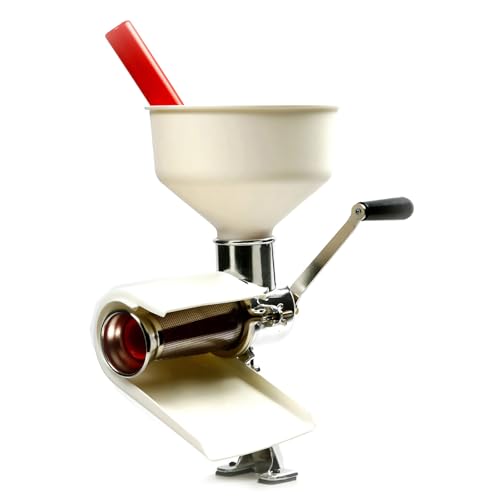
Best Multiuse Manual Pick – Norpro 1951 Sauce Master
The Norpro 1951 is a manual food strainer machine for large batches of vegetables, fruits, and purees. It forces food through a chrome-plated steel screen while separating juice and pulp in one operation, with a listed 3-quart capacity.
Best For: Cooks seeking a straightforward manual strainer for sauces, fruit preparations, and vegetable purees.
Pros:
- 3-quart, 95-ounce capacity supports substantial home batches.
- Automatically separates juice and pulp during straining.
- Includes a fine mesh screen, standard spiral, and recipe booklet.
- Additional berry, pumpkin, and salsa screens are available separately.
Cons:
- Manual operation requires turning the strainer by hand.
- Specialized screens are sold separately.
This model is a practical option for buyers who prefer a traditional manual workflow and want the ability to expand its uses with optional screens.
Best High-Volume Electric Pick – OMRA Spremy Electric Tomato Strainer
For especially demanding food strainer machines for large batches, the OMRA Spremy Model 850 is designed around electric tomato processing. Its maker states production of up to 330 pounds, or 150 kg, of tomatoes per hour while separating puree from skins and seeds.
Best For: High-volume tomato processing where electric operation and rapid throughput are priorities.
Pros:
- Rated production reaches up to 330 pounds of tomatoes per hour.
- Separates tomato puree from seeds and skins automatically.
- 1/4 HP motor uses a cooling fan for electric operation.
- Stainless steel hopper and die-cast metal housing support a sturdy build.
Cons:
- Listed for 220-volt corded power, so electrical compatibility matters.
- The supplied notes emphasize tomatoes and apples rather than a broad range of foods.
Its stated throughput makes the OMRA a compelling large-batch specialist, particularly for users processing substantial tomato harvests with compatible 220-volt power.
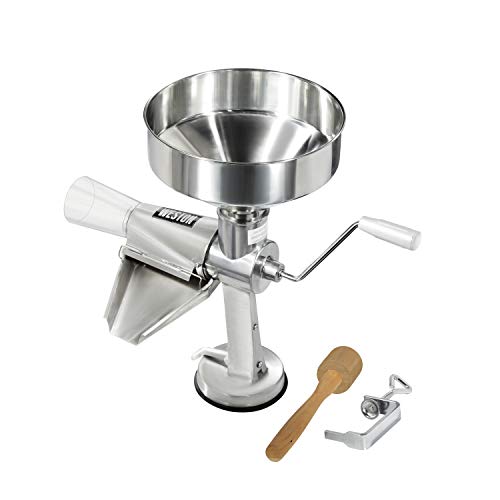
Best Large-Hopper Manual Pick – Weston Metal Tomato Strainer
The Weston Metal Tomato Strainer suits shoppers looking for food strainer machines for large batches with a one-gallon hopper. Its manual handle separates skins and seeds from tomatoes and other soft produce, while the dual-mount system supports kitchen or garden-table use.
Best For: Home preserving projects involving large loads of tomatoes, apples, soft fruits, jams, salsa, and purees.
Pros:
- One-gallon hopper helps process larger quantities without frequent refilling.
- Dual mount uses a suction-cup base and C-clamp for varied flat surfaces.
- Includes a stomper and 1.5mm multipurpose screen.
- Splash guard and chute help direct puree into a container while reducing mess.
Cons:
- Manual handle operation requires physical effort.
- Additional screens are available separately through the accessory kit.
The generous hopper and flexible mounting make this a useful manual choice for batch preserving, especially when you need to move processing between indoor and outdoor work surfaces.
Harvest-Ready Versatility – VEVOR Electric Tomato Strainer
For shoppers comparing food strainer machines for large batches, the VEVOR Electric Tomato Strainer combines steady motor output with multiple screen options. It is designed for sauces, purees, juices, salsa, and jam, with stainless steel components suited to repeated harvest-season use.
Best For: Home gardeners and canners processing tomatoes, fruit, and vegetables in varied textures.
Pros:
- Separates peels and seeds in a single pass for smoother sauces and purees.
- Includes 1 mm, 1.5 mm, 3 mm, and 6 mm screens for different textures and recipes.
- 304 stainless steel parts resist fruit acids and can be removed without tools.
- Guard cover helps reduce splatter, while the DC motor provides steady, low-noise operation.
Cons:
- The stated 88-pound-per-hour capacity is for purees and may vary with ingredients and preparation.
- At 7.2 pounds, it may have less heft than larger commercial-style machines.
With four screens and a motor intended for continuous sauce making, this VEVOR model is a flexible choice when batch size matters but recipe variety matters too.
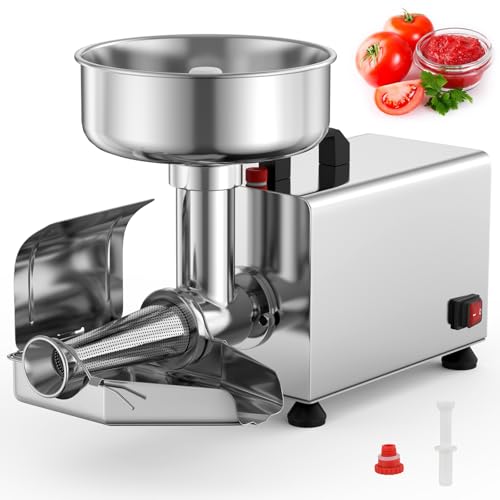
Commercial-Scale Throughput – COSTWAY 450W Tomato Strainer
If you need food strainer machines for large batches, the COSTWAY 450W Electric Tomato Strainer emphasizes throughput with a full-copper motor, large feed chute, and claimed 200-350 pounds-per-hour processing rate. Its stainless steel construction and tool-free disassembly also suit frequent preserving sessions.
Best For: High-volume home preservers and small operations processing large quantities of soft fruits and vegetables.
Pros:
- 450W motor and 8.5-inch feed chute are designed for efficient feeding and processing.
- Handles tomatoes, strawberries, blueberries, pineapples, and other fruit for sauces and preserves.
- Food-grade 304 stainless steel construction supports durability.
- Detachable parts are designed for tool-free disassembly and are dishwasher-safe according to the supplied notes.
Cons:
- At 22 pounds, it is substantially heavier and less convenient to move between storage and work areas.
- The supplied care instructions also specify hand washing, despite the detachable parts being described as dishwasher-safe.
This is the throughput-focused option in the group, with stability and safety features that make sense for demanding batch work, provided you have room for its larger footprint.
Proven Batch Control – Weston Deluxe Electric Tomato Strainer
The Weston Deluxe is a practical pick among food strainer machines for large batches, pairing a one-gallon hopper with a 250W two-speed motor. Its forward and reverse settings, three screens, and included stomper support sauces, jellies, salsa, and other preserving projects.
Best For: Home canners who want a large hopper and straightforward control for tomato and soft-produce processing.
Pros:
- One-gallon hopper accommodates larger quantities without constant refilling.
- Two speeds include reverse operation to help prevent jamming.
- Three stainless steel screens cover fine tomato and berry work, larger vegetable purees, and chunky salsa.
- Included stomper helps feed ingredients safely into the hopper.
Cons:
- Its 250W motor is lower-powered than the VEVOR and COSTWAY models in this roundup.
- The body combines plastic and stainless steel rather than using an all-stainless construction.
- Only three screens are included, compared with four for the VEVOR.
The Weston stands out for its generous hopper and reverse function, making it a balanced choice for home preserving when ease of feeding and jam-prevention features are priorities.
Large-Batch Home Preserves – 450W Stainless Steel Tomato Strainer
If you need food strainer machines for large batches but want straightforward operation, this 450W electric model is designed for quick processing of tomatoes, strawberries, and blueberries. Its large funnel, stainless steel construction, and ready-to-use assembly suit home kitchens and smaller commercial applications.
Best For: Home cooks and small commercial users making tomato sauce, fruit sauces, and jams in substantial quantities.
Pros:
- 450W motor is intended for processing large quantities efficiently.
- Stainless steel body resists corrosion, impact, and deformation.
- Comes assembled and uses a simple one-switch operation.
- Large funnel and adjustable trough help with feeding and sauce collection.
Cons:
- At 20.3 pounds, it is not especially lightweight to move.
- The notes do not specify an hourly processing capacity.
This is a practical choice when ease of setup and a sturdy stainless steel build matter more than a published commercial throughput rating. Heat-dissipation openings and a smooth surface also support routine use and cleanup.
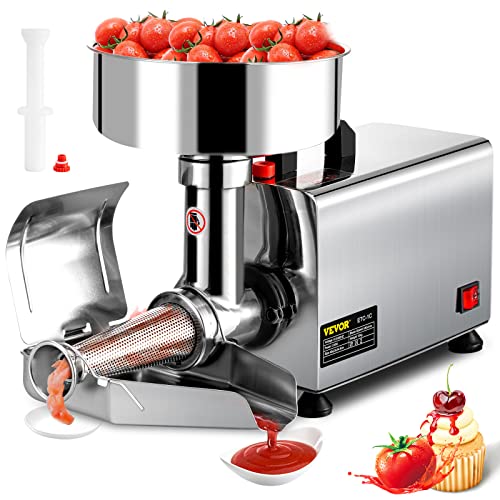
Commercial-Grade Value Pick – VBENLEM 370W Tomato Milling Machine
For shoppers comparing food strainer machines for large batches, the VBENLEM combines a 370W pure copper motor with a 9-inch feeding funnel and a stated capacity of up to 90–160 kg per hour. Its stainless steel food-contact components and adjustable trough make it suited to repeated sauce and jam preparation.
Best For: Users who want a commercial-style tomato and fruit sauce maker with a large feed opening and specified high-volume capability.
Pros:
- Rated for 90–160 kg/h processing according to the supplied notes.
- Pure copper motor is protected by a stainless steel outer casing.
- Food-contact components use 304 stainless steel and are easy to disassemble.
- Large 9-inch funnel and adjustable trough support continuous feeding and cleaner discharge.
Cons:
- Weighs 22 pounds, which may make storage or relocation less convenient.
- The 110V design requires a compatible AC power supply.
- The listed material details include both stainless steel and aluminum, so construction varies by component.
With its stated throughput, quiet operation, and washable design, this model is a strong fit for batch processing. Consider it when capacity and durable food-contact parts are priorities.
Highest Output Option – 450W 200–350 lb/h Tomato Strainer
This 450W machine stands out among food strainer machines for large batches with a stated output of 200–350 pounds per hour. It combines an 8.5-inch feed chute, all-copper motor, 304 stainless steel construction, and tool-free disassembly for users processing tomatoes and multiple types of fruit.
Best For: Busy home-preserving setups or commercial kitchens that need high stated throughput and versatile jam, sauce, and preserve production.
Pros:
- Stated capacity of 200–350 pounds of sauce per hour.
- 450W all-copper motor and 8.5-inch feed chute support high-output work.
- 304 stainless steel construction and detachable dishwasher-safe parts simplify cleanup.
- Safety pusher, enclosed motor guard, insulated switch, and anti-slip feet support controlled operation.
Cons:
- At 22 pounds, it is relatively substantial for a countertop appliance.
- Its high-output design may be more capacity than occasional users need.
- The listed mesh opening is 1.2 mm, which may not suit every desired texture.
This is the most throughput-focused option in the group. Its broader fruit compatibility and tool-free cleanup make it especially appealing when large preserving sessions are frequent and speed matters.
How We Picked the Best Food Strainer Machines for Large Batches
We focused on machines designed to process more than occasional single-jar quantities. Our comparison considers motor power, stated processing capacity, hopper and body materials, mounting stability, auger and screen design, versatility with different produce, and cleanup requirements. We also included both electric models and the manual-style Johnny Apple Sauce Maker and Norpro Sauce Master for shoppers who prefer simpler equipment or do not need powered operation.
Because published capacity ratings are not always measured under identical conditions, treat pounds-per-hour figures as guidelines rather than guaranteed results. Produce ripeness, preparation, screen selection, feeding speed, and the amount of pulp left in the waste stream can all affect real-world output.
Quick Comparison
| Best For | What to Prioritize |
|---|---|
| Large tomato harvests | High motor power, stable construction, and a large hopper |
| Commercial-style batches | Stainless steel components and a clearly stated throughput rating |
| Applesauce and mixed produce | Suitable screens, a reliable auger, and easy pulp adjustment |
| Occasional home preserving | Compact storage, simple assembly, and affordable replacement parts |
| Quiet or off-grid use | Manual operation or a lower-power design that matches your setup |
Key Buying Factors for Food Strainer Machines for Large Batches
Capacity and Motor Performance
Look beyond the wattage number. Rated power and maximum power may differ, and a higher figure does not automatically mean faster processing. Match the machine’s stated capacity to your typical harvest, while leaving headroom for tougher produce and extended runs. A machine with thermal protection and a durable drive system is preferable for repeated batches.
Materials and Durability
Stainless steel hoppers and body components resist stains and corrosion and are generally easier to sanitize. Plastic parts can reduce weight and cost, but check whether the auger, screen, clamps, and food-contact surfaces are robust enough for your intended volume. Confirm that replacement screens and wear parts are available before buying.
Setup, Feeding, and Cleanup
A secure clamp or wide base prevents movement when feeding produce. Consider how much cooking or chopping is required before straining, whether the hopper accepts large pieces, and how quickly the screen and auger can be removed. Dishwasher-safe parts, included brushes, and tool-free disassembly can save substantial time over a long preserving session.
Versatility and Electrical Requirements
Some machines are optimized for tomatoes, while others also handle cooked apples, berries, grapes, or soft vegetables. Verify the included screen and any recommended produce limitations. Electric models in this roundup commonly use 110–120V power, so check your outlet, cord placement, and duty-cycle requirements before purchase.
Who Should Buy Which Food Strainer Machines for Large Batches?
Choose a high-throughput stainless steel electric model if you regularly process garden harvests, supply a family, or make sauce for freezing and canning. A midrange electric strainer is a practical fit for most home preservers who want speed without commercial-scale equipment. Manual clamp-style machines make sense when you value portability, occasional use, or operation without electricity. For frequent mixed-produce processing, prioritize interchangeable screens, a stable mounting system, and readily available replacement parts over peak wattage alone.