The best manual food strainer machines make it easier to turn cooked tomatoes, apples, berries, and vegetables into smooth sauces, purées, and jams. The right model can separate skins and seeds while reducing prep time and cleanup.
This roundup compares 10 popular food mills, tomato presses, and sauce makers, including hand-operated and electric designs. Use the guide below to match capacity, materials, effort, and cleaning needs to your kitchen.
Best 10 Manual Food Strainer Machines Picks for 2026
Hand-Crank Versatility
Hungry Artisan 3-Disc Food Mill

- Three discs for coarse, medium, and fine textures
- Stainless steel construction for repeated use
- No outlet needed for manual operation
Best For: Applesauce, sauces, purees, and canning
Classic Sauce Processing
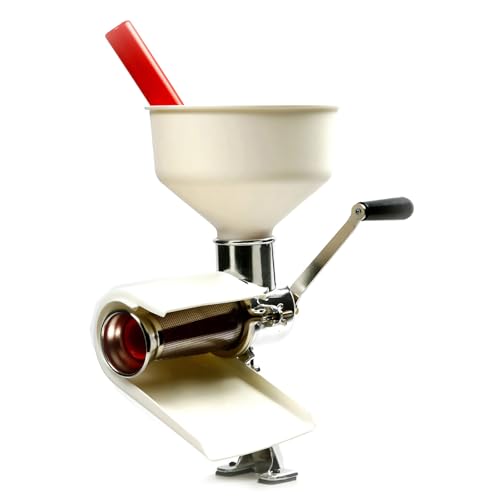
- 3-quart capacity for fruits, vegetables, and purees
- Separates juice and pulp in one operation
- Optional screens expand its uses
Best For: Sauces, fruit processing, and purees
Compact Tomato Prep
Tomato Strainer with Suction Mount

- Juices tomatoes without peeling, deseeding, or coring
- Suction-cup base helps stabilize the mill
- Includes a stainless steel pusher
Best For: Fresh tomato juice, sauce, and salsa
High-Volume Electric Processing

- 250-watt motor with forward and reverse speeds
- One-gallon hopper for larger batches
- Three stainless steel screens included
Best For: Canning, preserving, sauces, and salsa
Large-Batch Stainless Steel Pick
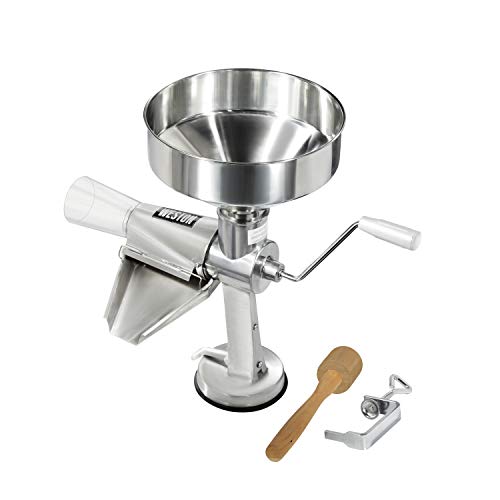
- 1-gallon stainless steel hopper
- Dual suction-cup and C-clamp mounting
- Includes stomper and 1.5mm screen
Best For: Large batches of sauces, purees, jams, and salsa
Simple Everyday Straining Pick
Manual Tomato Press Sauce Maker

- Stainless steel peel-and-seed filter
- Large produce feed inlet
- Machine-washable care instructions
Best For: Simple home tomato juicing and sauce making
High-Volume Electric Alternative

- Steady motorized operation for large batches
- Four screens for varied textures
- 304 stainless steel parts and cleaning brush
Best For: Continuous sauce making and harvest-season canning
Commercial Stainless Steel Pick
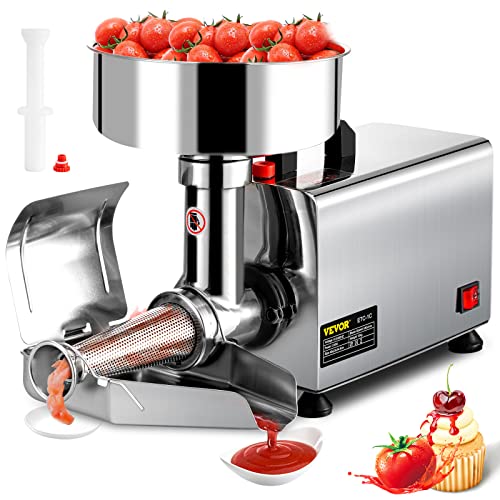
- 370W copper motor for large-batch processing
- 304 stainless steel food-contact parts
- Large funnel and adjustable sauce trough
Best For: High-volume sauces, purees, and jams
Versatile Screen Pick
VEVOR 800W Max Tomato Strainer

- Four screens for different textures
- Separates peels and seeds in one pass
- Lightweight 7.2-pound stainless steel design
Best For: Multi-purpose sauces, jams, salsas, and purees
Bulk Processing Pick

- Large hopper for fewer refills
- Designed for up to 200 pounds per hour
- Tool-free disassembly for faster cleanup
Best For: Harvest-season canning and large tomato batches
Hand-Crank Versatility – Hungry Artisan 3-Disc Food Mill
For shoppers comparing manual food strainer machines, the Hungry Artisan offers a straightforward hand-crank design with three stainless steel discs. It separates skins, seeds, and cores while letting you choose a coarse, medium, or fine texture.
Best For: Home cooks who want a versatile, outlet-free mill for applesauce, tomato sauce, purees, baby food, and canning.
Pros:
- Three discs provide coarse, medium, and fine textures.
- Stainless steel body, discs, and crank are designed for repeated use.
- Manual operation works anywhere without an outlet.
- Handles applesauce, sauces, mashed potatoes, baby food, and jam bases.
Cons:
- Manual cranking requires more hands-on effort than an electric strainer.
- The listed 2.8-pound weight and 15.5-inch length may require dedicated storage space.
This is a practical all-purpose choice when texture control and portability matter more than maximum batch speed.
Classic Sauce Processing – Norpro 1951 Sauce Master
The Norpro 1951 is a manual food strainer machine built for processing vegetables, fruits, and purees. Its 3-quart capacity and chrome-plated steel screen force food through while separating juice and pulp in one operation.
Best For: Cooks who need a dedicated sauce and puree strainer with a relatively large 3-quart capacity.
Pros:
- Processes up to 3 quarts, or 95 ounces.
- Automatically separates juice and pulp.
- Includes a fine mesh screen, standard spiral, recipe, and instruction booklet.
- Additional berry, pumpkin, and salsa screens are available separately.
Cons:
- Only the standard fine mesh screen is included.
- Additional specialized screens must be purchased separately.
- The listed dimensions are relatively substantial for a manual appliance.
The Sauce Master is a solid fit for regular sauce-making, especially if you may expand its capabilities with optional screens.
Compact Tomato Prep – Tomato Strainer with Suction Mount
This tomato strainer is a focused option among manual food strainer machines, designed to juice and puree tomatoes without peeling, deseeding, or coring. A suction-cup base helps secure the food mill while skins and seeds exit to the side.
Best For: Gardeners and home cooks making fresh tomato juice, pasta sauce, salsa, or potato puree.
Pros:
- Processes tomatoes without requiring peeling, deseeding, or coring.
- Suction mount helps keep the mill stable during use.
- Includes a stainless steel pusher for guiding tomatoes into the unit.
- Suitable for straining, juicing, and pureeing tomatoes.
Cons:
- Its listed recommended uses focus mainly on tomatoes and related preparations.
- The plastic construction may appeal less to shoppers seeking an all-stainless-steel mill.
- Manual operation requires hands-on feeding and pressing.
Choose this model when tomato preparation is the priority and a stable suction-mounted design is more useful than broad, multi-screen versatility.
High-Volume Electric Processing – Weston Deluxe Tomato Strainer
Although it uses powered operation, the Weston Deluxe is worth comparing with manual food strainer machines when processing speed and batch capacity are priorities. Its 250-watt motor, 1-gallon hopper, reverse function, and three screens are designed for sauces, purees, jellies, and salsa.
Best For: Canning and preserving projects involving garden harvests or other large batches of soft fruits and vegetables.
Pros:
- One-gallon hopper supports larger processing batches.
- 250-watt motor offers forward and reverse speeds.
- Includes 1.5mm, 3mm, and 6mm stainless steel screens.
- Removes skins and separates seeds without coring.
Cons:
- Requires a 120-volt AC power source, unlike manual models.
- Its 14-by-12-by-17-inch footprint may need considerable counter or storage space.
- Powered operation may be more equipment than occasional small-batch users need.
This is the strongest choice here for throughput, but shoppers specifically seeking hand-powered equipment should consider one of the manual alternatives instead.
Large-Batch Stainless Steel Pick – Weston Metal Tomato Strainer
For shoppers comparing manual food strainer machines, the Weston stands out with a stainless steel hopper, a 1-gallon capacity, and a dual-mount system. It is designed to process tomatoes, apples, and other soft produce without peeling or coring first.
Best For: Home cooks making large batches of sauces, purees, jams, preserves, or salsa.
Pros:
- 1-gallon stainless steel hopper supports larger batches.
- Suction-cup base and C-clamp provide flexible mounting.
- Includes a stomper and 1.5mm multipurpose screen.
- Splash guard and directed chute help reduce mess.
Cons:
- Additional screens require a separately sold accessory kit.
- Its manual design requires continuous handle turning.
The Weston is a practical choice when durability, mounting flexibility, and batch capacity matter more than electric operation. Its included screen is suited to common tomato and apple preparations, while optional screens expand its uses.
Simple Everyday Straining Pick – Manual Tomato Press Sauce Maker
This compact option is a straightforward choice among manual food strainer machines. Its stainless steel filter separates peel and seeds from pulp, while the large feed inlet accommodates more fruit or vegetables during each loading cycle.
Best For: Budget-conscious home users who want a simple manual tomato juicer for sauces and juices.
Pros:
- Stainless steel filter supports peel-and-seed separation.
- Large feed inlet can hold more produce.
- Simple structure is intended to be easy to clean.
- PP housing is described as wear-resistant and durable.
Cons:
- The supplied notes do not list included components beyond the main product.
- It offers less documented batch capacity than the larger-hopper models.
Choose this press if you value uncomplicated operation and a washable, machine-washable design. Its adjustable feature and high-yield positioning may appeal to everyday kitchen use, though the notes provide fewer details about accessories and mounting.
High-Volume Electric Alternative – VEVOR 800W Tomato Strainer
Although it is powered rather than fully manual, this VEVOR model is worth comparing with manual food strainer machines if you process harvest-sized batches. Its motor provides steady output, and the included screens accommodate several sauce and puree textures.
Best For: Large-batch sauce making, continuous straining, and home canning during harvest season.
Pros:
- Motorized operation reduces repeated hand cranking.
- Includes 1mm, 1.5mm, 3mm, and 6mm screens.
- 304 stainless steel parts resist fruit acids and wear.
- Guard cover helps reduce juice splatter.
Cons:
- It is electric, so it does not offer the simplicity of a manual machine.
- Its 300W rated power and 800W maximum are different specifications to consider.
- At 7.2 pounds, it is less lightweight than a basic hand-operated press.
The VEVOR is the strongest fit here for users prioritizing speed, sustained operation, and texture flexibility. Tool-free removable core components and a cleaning brush also make maintenance more manageable after larger processing sessions.
Commercial Stainless Steel Pick – VBENLEM 370W Tomato Strainer
For shoppers comparing manual food strainer machines with powered alternatives, the VBENLEM offers a sturdy electric setup for processing tomatoes and making sauces. Its 370W copper motor, 304 stainless steel food-contact parts, adjustable trough, and 9-inch funnel are geared toward larger batches and easier feeding.
Best For: High-volume tomato sauce, ketchup, jam, and puree processing.
Pros:
- Food-contact components use 304 stainless steel and the body is designed for durability.
- 370W pure copper motor supports substantial batch processing.
- Large 9-inch funnel, adjustable trough, and trough brace improve feeding and sauce discharge.
- Designed for relatively quiet operation and easier cleaning.
Cons:
- At 22 pounds, it is less convenient to move and store than smaller models.
- Its 110V electric design is less portable than a manual strainer.
- The supplied specifications list a stainless-steel construction in the features but aluminum as the material type.
This is a capable choice when throughput and durable food-contact components matter more than portability. The larger footprint and electric power requirement make it better suited to a dedicated prep area than occasional countertop use.
Versatile Screen Pick – VEVOR 800W Max Tomato Strainer
Among manual food strainer machines and electric food mills, this VEVOR model stands out for its interchangeable screens. It separates peels and seeds while offering four screen sizes for adjusting textures across tomato sauce, jam, puree, salsa, and juice.
Best For: Cooks who want one compact machine for multiple sauce and puree textures.
Pros:
- Includes 1 mm, 1.5 mm, 3 mm, and 6 mm screens for varied results.
- Stainless steel filter separates seeds and peels in a single pass.
- 304 stainless steel parts resist fruit acids and wear.
- Removable core components and a cleaning brush simplify cleanup.
Cons:
- The listed output is 88 pounds per hour, which may be less suitable for the largest harvest batches.
- It is electric rather than manually operated.
- The supplied details list an 800W maximum and 300W rated power, so buyers should distinguish peak from operating power.
With multiple screens and a relatively light 7.2-pound build, this model offers useful flexibility without the bulk of a larger commercial-style unit. It is a practical option for households that value texture control and easier handling.
Bulk Processing Pick – VEVOR 370W Food Mill
For buyers considering manual food strainer machines for harvest-season canning, this VEVOR electric food mill emphasizes capacity and repeatable batch processing. Its 370W motor, large hopper, stainless steel processing parts, and tool-free disassembly are suited to turning tomatoes into smooth sauce with less manual effort.
Best For: Frequent bulk canning and processing large quantities of tomatoes.
Pros:
- Rated for up to 200 pounds per hour according to the product title.
- Large hopper reduces the need for frequent refilling.
- Stainless steel hopper, filter screen, juice tray, and guard help resist fruit acids and wear.
- Core components disassemble without tools for quick rinsing.
Cons:
- At 21.7 pounds, it is relatively heavy for occasional use.
- Tomatoes should be cut into small pieces to help reduce clogging.
- Electric operation requires a suitable power source and is not as portable as a manual mill.
This model is strongest for shoppers prioritizing throughput, hopper capacity, and straightforward cleanup. Its size and batch-focused design make it a better fit for regular canning than for small, occasional sauce-making tasks.
How We Picked These Manual Food Strainer Machines
We focused on the features that matter most when processing sauces, fruit, and vegetables at home or in higher-volume kitchens. The selection includes classic hand-crank food mills, manual tomato presses, and electric straining machines so shoppers can compare convenience and output in one place.
We considered hopper size, construction, straining performance, drive style, expected workload, cleaning requirements, and suitability for canning preparation. Because product specifications and included screens can vary, confirm the current listing details before buying.
Quick Comparison
| Best For | Look For | Main Trade-Off |
|---|---|---|
| Occasional applesauce or purée | Compact manual food mill with interchangeable discs | Requires hand cranking |
| Tomato sauce and salsa prep | Stable clamp, auger, and efficient seed-and-skin separation | More parts to clean |
| Large harvests | Electric motor, generous hopper, and durable metal components | Higher price and storage needs |
| Frequent canning | Reliable throughput, replacement screens, and easy assembly | May need additional counter space |
Key Buying Factors for Manual Food Strainer Machines
Manual or Electric Operation
Hand-operated mills are quiet, simple, and useful when processing small batches. They do not require an outlet and typically offer straightforward cleanup. Electric models reduce physical effort and are better suited to repeated batches, but they add motor noise, electrical components, and storage considerations.
Capacity and Throughput
Check the hopper size and any stated processing rate. A small food mill may be ideal for a saucepan of applesauce, while a large tomato press is more practical for garden harvests or canning days. Do not choose based on advertised capacity alone; preparation time and feeding speed also affect real output.
Materials, Stability, and Screens
Stainless steel and sturdy metal parts generally tolerate frequent use better than lightweight plastic components. A strong clamp or stable base helps prevent movement during cranking. Interchangeable screens or discs let one machine handle different textures, from chunky purée to smoother sauce.
Cleaning and Food Compatibility
Look for removable screens, accessible augers, and parts that can be rinsed promptly after use. Confirm whether components are dishwasher-safe rather than assuming they are. Also check the manufacturer’s guidance for hot foods, acidic tomatoes, and the size of produce that can enter the hopper.
Who Should Buy Which Manual Food Strainer Machines?
Choose a compact manual mill if you make occasional applesauce, baby food, mashed vegetables, or small sauce batches and prefer simple equipment.
Choose a manual tomato press if you want efficient skin-and-seed separation without relying on electricity. This is a practical middle ground for home gardeners and weekend canners.
Choose an electric strainer if you process large quantities, have limited hand strength, or regularly prepare tomato sauce for freezing or canning. Prioritize motor durability, hopper capacity, replacement parts, and a stable setup.
Whichever style you select, prepare produce in manageable pieces, avoid overloading the hopper, and clean the strainer soon after use. Those habits help improve consistency and extend the machine’s service life.