Making sauce, salsa, and passata from fresh tomatoes is much easier with the right press. The best tomato presses for canning separate skins and seeds efficiently while producing a smooth base with less hand strain and cleanup.
This roundup compares 10 manual and electric models, from compact food mills to high-capacity stainless steel machines, so you can match your equipment to your batch size, workspace, and canning routine.
Best 10 Tomato Presses for Canning Picks for 2026
High-Volume Electric Pick
OMRA Spremy Electric Tomato Strainer

- Processes up to 330 pounds per hour
- Separates skins and seeds automatically
- 1/4 HP motor with metal and stainless components
Best For: Large batches of tomato puree and sauce
Versatile Sauce-Making Pick
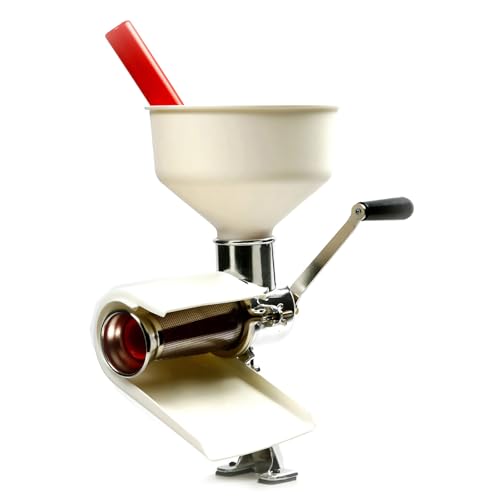
- 3-quart/95-ounce capacity
- Separates juice and pulp in one operation
- Includes fine mesh screen and standard spiral
Best For: Multi-purpose home sauce and puree making
Simple Suction-Mount Pick

- No peeling, coring, or deseeding required
- Suction mount supports stable use
- Includes stainless steel pusher
Best For: Small-batch tomato juice, puree, and salsa
Flexible Manual Food Mill Pick
Stainless Steel Food Mill With 3 Discs

- Three discs provide adjustable textures
- Stable dual-hook manual design
- Dishwasher-safe stainless steel construction
Best For: Multi-purpose tomato sauce, puree, and canning preparation
Best Manual Jumbo Press
Norpro Manual Jumbo Tomato Strainer
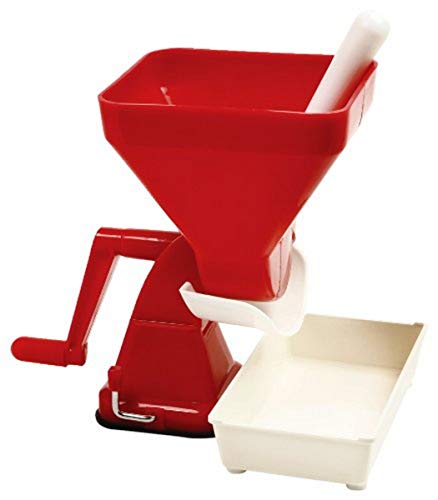
- Stainless mesh separates seeds, skins, and stems
- 2.25-quart hopper for larger batches
- Suction base and included canning-prep accessories
Best For: Manual tomato sauce, puree, and applesauce preparation
Best Large-Hopper Manual Press
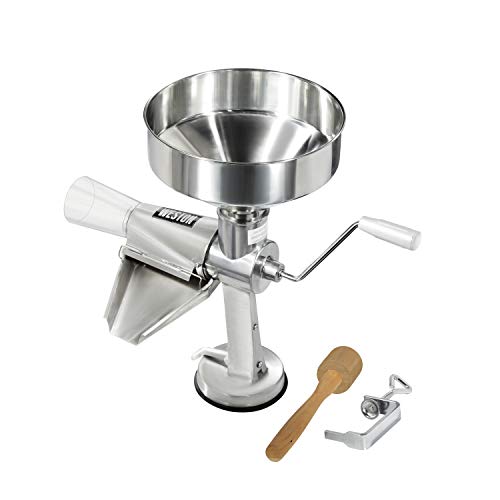
- One-gallon hopper for substantial batches
- Suction-cup and C-clamp mounting options
- Includes splash guard, stomper, and 1.5mm screen
Best For: Large-batch manual sauce and puree processing
Best Electric Batch Press
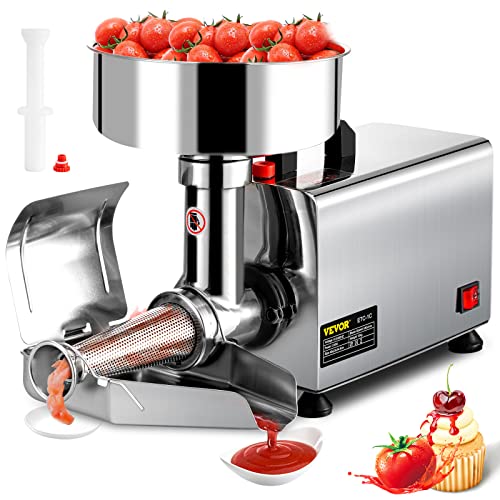
VEVOR Electric Tomato Strainer

- Powered operation for continuous sauce making
- Four screens for varied sauce and puree textures
- 304 stainless steel parts with splatter guard
Best For: Large harvest batches and lower-effort processing
Best Manual Option
Stainless Steel Food Mill for Canning

- Stainless steel and dishwasher safe
- Includes multiple grinding plates
- Handles hot foods over pots or bowls
Best For: Small-batch sauces, purees, and occasional home canning
Best All-Around Electric Pick
Weston Deluxe Electric Tomato Strainer

- 250-watt motor with reverse speed
- One-gallon hopper for larger batches
- Three stainless steel screens included
Best For: Home canning, sauces, purees, and garden harvests
Best High-Volume Choice
VBENLEM 370W Commercial Tomato Strainer
- 370-watt pure copper motor
- 304 stainless steel food-contact parts
- Nine-inch funnel and adjustable trough
Best For: Frequent, high-volume sauce and tomato processing
High-Volume Electric Pick – OMRA Spremy Electric Tomato Strainer
For shoppers comparing tomato presses for canning, the OMRA Spremy is a powerful electric option designed to process fresh or cooked tomatoes without manually separating skins and seeds. Its 1/4 HP motor and masticating-style worm support high-volume preparation.
Best For: Large batches of tomato puree and sauce preparation.
Pros:
- Automatically separates puree from seeds and skins.
- Rated for processing up to 330 pounds of tomatoes per hour.
- Features a die-cast metal housing, stainless steel hopper, and food-grade nylon auger.
- Cooling fan and 110 RPM worm rotation support extended processing.
Cons:
- Requires a corded 220-volt power source.
- Its electric design may be more equipment than occasional users need.
The OMRA stands out for serious tomato-processing sessions, especially when speed and automated straining matter more than compact manual operation.
Versatile Sauce-Making Pick – Norpro 1951 Sauce Master
The Norpro 1951 is a versatile choice among tomato presses for canning, using a hand-operated straining system to separate juice and pulp in one operation. It includes a fine mesh screen and is designed for vegetables, fruits, and purees.
Best For: Home cooks who want one strainer for tomatoes, sauces, fruits, and purees.
Pros:
- Separates juice and pulp automatically through a chrome-plated steel screen.
- Includes a standard fine mesh screen, standard spiral, recipes, and instructions.
- Has a 3-quart/95-ounce capacity.
- Additional berry, pumpkin, and salsa screens are available separately.
Cons:
- Additional specialty screens are not included.
- Its listed dimensions are relatively large for a countertop strainer.
With its multi-use design and expandable screen options, the Sauce Master is a practical middle ground for cooks who want tomato straining plus broader fruit and vegetable versatility.
Simple Suction-Mount Pick – Manual Tomato Strainer
This manual tomato strainer is a straightforward option for shoppers seeking tomato presses for canning without peeling, coring, or deseeding beforehand. It uses a suction mount and directs skins and seeds to the side while juice flows into the tray.
Best For: Small-batch tomato juicing, pureeing, salsa, and farm-to-table cooking.
Pros:
- Strains tomatoes without requiring peeling, deseeding, or coring.
- Suction mount helps secure the food mill during use.
- Includes a stainless steel pusher for guiding tomatoes into the strainer.
- Designed for juicing, pureeing, and homemade salsa.
Cons:
- Manual operation may be less convenient for very large batches.
- The supplied notes do not specify capacity or screen options.
Its uncomplicated design makes it appealing for seasonal kitchen use, particularly when you want fresh tomato juice or puree with minimal preparation.
Flexible Manual Food Mill Pick – Stainless Steel Food Mill With 3 Discs
For flexible tomato presses for canning, this stainless steel food mill offers manual control and three milling discs for adjusting texture. It can process tomato sauce as well as potatoes, fruits, vegetables, jams, and other puree-style foods.
Best For: Cooks who want a dishwasher-safe food mill for tomatoes and multiple other foods.
Pros:
- Includes three milling discs with different pore sizes.
- Dual hooks and a soft silicone-covered crank help stabilize handling.
- Made from food-grade stainless steel with a mirror-polished surface.
- Dishwasher-safe and supplied with a multifunctional spoon, funnel, and measuring spoon.
Cons:
- Manual cranking requires more hands-on effort than an electric strainer.
- Its food-mill design may produce a different texture than a dedicated tomato press.
This model is a useful multipurpose option when adjustable texture, compact manual operation, and easy cleanup are priorities alongside tomato sauce preparation.
Best Manual Jumbo Press – Norpro Manual Jumbo Tomato Strainer
If you want tomato presses for canning that can also handle applesauce and other soft produce, the Norpro Manual Jumbo Tomato Strainer is a practical countertop option. Its stainless steel mesh separates seeds, skins, and stems while the 2.25-quart hopper supports larger batches.
Best For: Home canners who want a manual press for tomato sauce, puree, juice, paste, salsa, or applesauce.
Pros:
- Stainless steel mesh automatically separates seeds, skins, and stems.
- Large 2.25-quart hopper and 1.25-quart receiving tray suit batch processing.
- Suction base helps secure the press to smooth countertops.
- Includes a pestle, tray, instructions, and starter recipes.
Cons:
- Manual cranking requires more effort than an electric press.
- The suction base is designed for smooth surfaces.
Choose this model when versatility and a relatively large hopper matter more than motorized speed. Its included accessories and quick-disassembly design make it well suited to occasional or seasonal canning preparation.
Best Large-Hopper Manual Press – Weston Metal Tomato Strainer
For tomato presses for canning with a full-gallon hopper, the Weston Metal Tomato Strainer is built for processing substantial amounts of produce. Its stainless steel construction, dual mounting system, and included 1.5mm screen make it useful for sauces, purees, jams, and preserves.
Best For: Large-batch manual processing when a one-gallon hopper and flexible countertop mounting are priorities.
Pros:
- One-gallon stainless steel hopper supports large batches.
- Dual mount system uses either a suction cup or C-clamp.
- Separates skins and seeds without peeling or coring first.
- Includes a stomper, splash guard, and 1.5mm multipurpose screen.
Cons:
- Additional screens are sold separately.
- Manual operation may be less convenient for continuous processing.
The Weston is a strong fit for gardeners and home canners who process harvest-sized quantities by hand. Its mounting flexibility is especially useful when moving between kitchen counters and outdoor work surfaces.
Best Electric Batch Press – VEVOR Electric Tomato Strainer
If speed and reduced manual effort are important when comparing tomato presses for canning, the VEVOR Electric Tomato Strainer offers powered continuous processing. Its motorized design separates peels and seeds, while four included screens accommodate different sauces, purees, jams, and salsa textures.
Best For: Harvest-season canning and continuous processing when electric operation and multiple screen sizes are useful.
Pros:
- Electric motor provides steady power for continuous sauce making.
- Includes 1mm, 1.5mm, 3mm, and 6mm screens for different textures.
- 304 stainless steel components resist fruit acids and wear.
- Guard cover helps reduce splatter, and removable parts support cleaning.
Cons:
- Requires access to electrical power.
- At 7.2 pounds, it is heavier than some basic manual presses.
This VEVOR model makes the most sense for users processing larger harvests who want to avoid extended hand cranking. The included screen range adds flexibility, while the cleaning brush and removable core components simplify cleanup after a batch.
Best Manual Option – Stainless Steel Food Mill for Canning
For small-batch tomato presses for canning, this manual stainless steel food mill offers a straightforward way to puree tomatoes and separate soft foods. Its interchangeable plates also support sauces, applesauce, jellies, and baby food.
Best For: Home cooks who want a compact, manually operated tool for occasional tomato sauce and puree preparation.
Pros:
- Stainless steel construction is sturdy, stain-resistant, and dishwasher safe.
- Includes thin, medium, and coarse grinding options plus a thick plate.
- Non-slip handles and rounded edges help with processing hot food over a pot or bowl.
Cons:
- Manual operation requires more effort than an electric tomato strainer.
- The notes do not specify a hopper capacity or batch-processing rate.
This is a versatile choice for cooks who value simple cleanup and adjustable textures over high-volume processing. It is better suited to smaller batches than large harvests.
Best All-Around Electric Pick – Weston Deluxe Electric Tomato Strainer
The Weston Deluxe is a practical electric option among tomato presses for canning, with a 250-watt motor and one-gallon hopper for processing tomatoes and other soft produce. It removes skins and separates seeds without coring.
Best For: Home preservers who need electric assistance for garden harvests, sauces, purees, jellies, or salsa.
Pros:
- One-gallon hopper supports larger batches than a manual food mill.
- Forward and reverse motor speeds help with processing and jam prevention.
- Three stainless steel screens provide 1.5mm, 3mm, and 6mm texture options.
- Includes a stomper and a one-year manufacturer warranty.
Cons:
- Requires access to a 120-volt AC power source.
- Its plastic and stainless steel construction may be less heavy-duty than a full stainless commercial machine.
With a useful hopper size, reversible motor, and multiple screens, this model balances convenience and flexibility for typical home canning sessions.
Best High-Volume Choice – VBENLEM 370W Commercial Tomato Strainer
For demanding batches, the VBENLEM is a commercial-style electric option among tomato presses for canning. It combines a 370-watt pure copper motor with food-contact 304 stainless steel parts and a large feeding funnel.
Best For: Frequent processors handling substantial quantities of tomatoes, fruit sauces, ketchup, or jams.
Pros:
- 370-watt pure copper motor is designed for powerful electric processing.
- Food-contact components use 304 stainless steel and are easy to disassemble.
- Nine-inch funnel supports generous feeding, while the adjustable trough helps direct sauce.
- Low-noise operation and a splash-reducing trough brace add convenience.
Cons:
- At 22 pounds, it is substantially heavier than a compact manual mill.
- Its 110-volt electric design requires a suitable AC outlet.
- The commercial-style footprint may be more machine than occasional users need.
This machine makes the most sense when throughput and durable food-contact materials matter more than portability. Its larger, heavier design is geared toward serious sauce and preservation work.
How We Picked the Best Tomato Presses for Canning
We focused on the features that matter during real preserving sessions: separation performance, hopper capacity, construction, power or hand-crank effort, cleanup, stability, and expected batch volume. The lineup includes manual strainers for occasional use, electric models for larger harvests, and food mills that offer added versatility for potatoes, jams, and other soft foods.
Because specifications and included accessories can vary by seller, confirm the current product details before ordering. Pay particular attention to voltage, motor ratings, replacement screens, mounting hardware, and dishwasher-safe components.
Quick Comparison
- Best for large harvests: Choose a powered model with a generous hopper and continuous-feed design.
- Best for occasional canning: A manual sauce maker or food mill keeps the purchase price and storage needs lower.
- Best for durability: Stainless steel components and a sturdy frame are useful for frequent seasonal batches.
- Best for flexibility: A food mill with multiple discs can handle tomatoes, sauces, jams, and mashed vegetables.
Key Buying Factors for Tomato Presses for Canning
Manual or Electric Operation
Manual presses are quiet, simple, and independent of an outlet, but they require more cranking and may process less fruit per hour. Electric presses reduce physical effort and are better suited to garden harvests, though they cost more and need space near a power source.
Capacity and Throughput
Check the hopper size and stated output rather than relying only on motor wattage. A larger hopper can reduce refilling, while a stable continuous-feed design helps when processing several baskets of tomatoes. Advertised capacity may depend on tomato variety, preparation, and operating technique.
Materials, Screens, and Cleanup
Stainless steel is a practical choice for durability and stain resistance. Look for removable screens, augers, and splash guards that are easy to rinse. Fine and coarse screens let you adjust texture, but verify which screens are included and whether replacements are available.
Stability and Safety
A secure clamp, wide base, or non-slip feet prevent the machine from shifting during use. For electric units, confirm the voltage and look for overload protection, ventilation, and controls that are easy to reach while feeding tomatoes.
Who Should Buy Which Tomato Presses for Canning?
Choose a compact manual mill if you make a few jars at a time, have limited storage, or want a tool that also handles potatoes and jams. Choose a manual jumbo strainer if you want greater capacity without committing to an electric appliance.
Choose a standard electric press for regular home canning and medium-sized garden harvests. Choose a commercial-style stainless steel machine only when you routinely process large volumes and have adequate counter space, electrical access, and a cleanup plan. For any model, prioritize dependable separation, secure operation, and readily available replacement parts over headline power numbers alone.