Small-batch sauce production demands more than a household food mill. The right tomato press can reduce prep time, separate skins and seeds consistently, and help a small business process harvests or incoming produce with less manual labor.
This roundup compares 10 manual and electric tomato presses across capacity, motor power, materials, throughput, and usability so you can match equipment to your production volume, workspace, and budget.
Best 10 Tomato Presses for Small Businesses Picks for 2026
High-Volume Electric Pick
OMRA Spremy Electric Tomato Strainer

- Up to 330 lb of tomatoes per hour
- Separates seeds and skins automatically
- Compact 1/4 HP, 220V design
Best For: Small businesses needing high-throughput purée extraction
Small-Batch Manual Pick
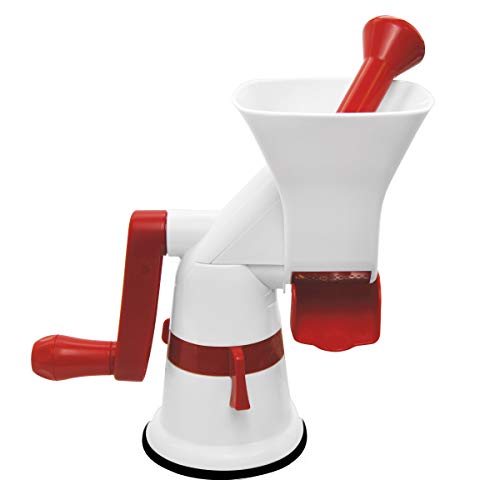
- Manual operation needs no electricity
- Three-cup capacity for modest batches
- 2 mm stainless steel screen
Best For: Small sauce, jam, and juice batches
Commercial Capacity Pick
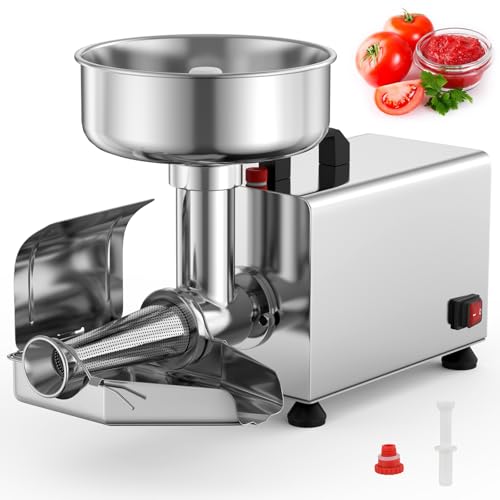
- Rated for 200–350 lb per hour
- 304 stainless steel construction
- Tool-free, dishwasher-safe detachable parts
Best For: High-volume small commercial kitchens and preserve makers
Compact Suction-Mount Pick

- No peeling, deseeding, or coring required
- Suction-cup base and stainless steel pusher
- Compact manual design for easy storage
Best For: Occasional low-volume sauces, juices, and salsa
Best All-Around Electric Pick
Weston Deluxe Electric Tomato Strainer

- 1-gallon hopper for larger batches
- 250-watt motor with reverse function
- Three screens for varied textures
Best For: Small businesses needing versatile electric straining
Best Commercial-Capacity Option
ARINOO 450W Stainless Tomato Strainer

- Processes up to 330 pounds per hour
- 304 stainless-steel commercial construction
- Five-year warranty and lifetime support
Best For: Restaurants, farms, and commercial kitchens
Best Manual Budget Choice
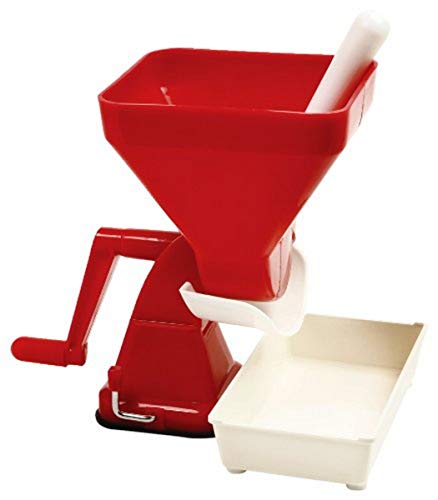
- Manual design needs no electricity
- 2.25-quart hopper with receiving tray
- Suction base stabilizes on smooth surfaces
Best For: Moderate batches and low-complexity production
High-Capacity Pick
VBENLEM 370W Commercial Tomato Strainer
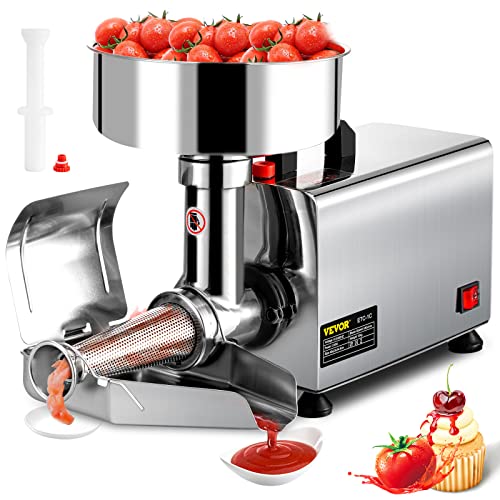
- 370W pure copper motor for batch processing
- 9-inch funnel and adjustable discharge trough
- Stainless-steel construction with 304 food-contact parts
Best For: Small commercial kitchens handling larger sauce batches
Versatile Screen Pick
VEVOR Electric Tomato Strainer

- Four screens for sauces, jams, salsa, and purees
- Separates peels and seeds in a single pass
- Removable 304 stainless-steel parts and cleaning brush
Best For: Businesses making products with varied textures
Commercial Efficiency Pick

- 450W motor with 8.4-inch stainless-steel funnel
- Stated output of up to 110 pounds per hour
- Protected motor housing and included pestle
Best For: Small shops and fruit markets needing efficient sauce production
High-Volume Electric Pick – OMRA Spremy Electric Tomato Strainer
For small businesses looking for tomato presses for small businesses, the OMRA Spremy is a compact electric option designed for substantial batch processing. Its 1/4 HP motor and masticating-style auger are rated for up to 330 pounds of fresh or cooked tomatoes per hour.
Best For: Small food businesses and producers needing high-throughput tomato purée extraction in a portable machine.
Pros:
- Processes up to 330 pounds of tomatoes per hour.
- Separates seeds and skins automatically.
- Features a die-cast metal housing, stainless steel hopper, and food-grade nylon auger.
- Made in Italy with a motor cooling fan.
Cons:
- Uses a 220-volt power supply, which may not suit every workspace.
- Its listed 1.1 kg weight and compact size may indicate a smaller feed setup than larger commercial machines.
The OMRA offers an appealing balance of compact construction and impressive stated throughput. Confirm that your facility supports 220 volts before choosing it for business use.
Small-Batch Manual Pick – Weston Fruit & Tomato Press
The Weston Fruit & Tomato Press is a manual choice for tomato presses for small businesses that process limited quantities or want a simple backup tool. Turning the handle separates seeds and skins from pulp without requiring electricity.
Best For: Small-batch sauce, jam, baby-food, and juice production where a three-cup capacity is sufficient.
Pros:
- Manual operation works without electricity.
- Three-cup capacity suits compact batches.
- Stainless steel screen uses 2 mm holes.
- Includes a stomper and an auger designed to help prevent jamming and leaking.
Cons:
- Manual winding is slower and more labor-intensive than electric models.
- The three-cup capacity is limited for larger production runs.
This Weston model is practical when simplicity, portability, and modest batch sizes matter more than speed. It is best viewed as a low-volume processor or supplemental press.
Commercial Capacity Pick – COSTWAY 450W Tomato Strainer
For businesses comparing tomato presses for small businesses with higher production demands, the COSTWAY electric strainer offers a commercial-grade stainless steel build and a stated output of 200 to 350 pounds per hour. Its large feed chute and 450W copper motor are designed for efficient processing.
Best For: Small commercial kitchens, farm businesses, and preserve makers processing tomatoes and other fruit at high volume.
Pros:
- Rated to process 200–350 pounds per hour.
- Large 8.5-inch feed chute and included safety pusher support steady feeding.
- Food-grade 304 stainless steel construction.
- Detachable parts are dishwasher-safe and designed for tool-free disassembly.
Cons:
- At 22 pounds and 20.5 inches deep, it requires more counter and storage space.
- The product notes specify hand washing for care, despite dishwasher-safe detachable parts.
- Its 110–120V requirement should be matched to the intended workspace.
The COSTWAY is the strongest throughput-oriented option in this group, with safety and cleaning features suited to frequent use. Its larger footprint and electrical requirements should be planned for before purchase.
Compact Suction-Mount Pick – Tomato Strainer Food Mill
This compact tomato strainer is a straightforward option for tomato presses for small businesses that need occasional juicing, straining, or puréeing. Its suction-cup base holds the plastic food mill in place while skins and seeds are directed aside and juice collects on the tray.
Best For: Very small food operations, farm-to-table preparation, and occasional fresh salsa or sauce making.
Pros:
- Strains tomatoes without peeling, deseeding, or coring first.
- Suction-cup base helps secure the mill during use.
- Includes a stainless steel pusher.
- Compact 9-by-6-by-8-inch design is easy to store.
Cons:
- Plastic construction may be less suited to heavy commercial workloads.
- No production capacity or electric motor is specified.
- Suction mounting requires a compatible smooth work surface.
This model is best for low-volume preparation where compact storage and simple operation are priorities. Businesses processing tomatoes regularly or at scale may need a higher-capacity electric or metal press.
Best All-Around Electric Pick – Weston Deluxe Electric Tomato Strainer
For small businesses seeking tomato presses for small businesses, the Weston Deluxe offers a practical balance of batch capacity, versatility, and straightforward electric operation. Its 250-watt motor, 1-gallon hopper, reverse function, and three screens support sauces, purees, jellies, and salsa.
Best For: Small food businesses and serious home processors that need flexible electric straining for regular canning and sauce preparation.
Pros:
- One-gallon hopper supports larger batches.
- Two-speed motor includes reverse to help prevent jams.
- Three screens handle smooth or chunkier preparations.
- Includes a stomper for safer feeding.
Cons:
- The plastic and stainless-steel construction may be less heavy-duty than an all-stainless commercial machine.
- Its one-year warranty is shorter than some commercial alternatives.
The Weston is a versatile choice when a business wants one machine for several soft-produce preparations rather than a dedicated high-volume commercial press. Its moderate 250-watt motor and 4-liter capacity are best suited to small-batch production.
Best Commercial-Capacity Option – ARINOO 450W Stainless Tomato Strainer
Among tomato presses for small businesses, the ARINOO stands out for its stated commercial throughput and stainless-steel construction. Its 450-watt copper motor is rated to process up to 330 pounds per hour, while the enclosed motor housing and included pusher support safer operation.
Best For: Restaurants, farms, and commercial kitchens that prioritize high stated throughput and durable, rust-resistant construction.
Pros:
- Stated processing capacity reaches up to 330 pounds per hour.
- Food-grade 304 stainless-steel construction is rust-resistant.
- Dual-channel design separates skins and seeds without an extra filter.
- Includes a five-year manufacturer warranty and lifetime customer support.
Cons:
- Continuous operation should be limited to 15 minutes followed by a five-minute cool-down.
- Hand-wash-only care may add cleanup time.
- At 20.9 pounds, it is less portable than smaller presses.
This is the strongest fit here for businesses processing substantial volumes, provided the stated duty-cycle guidance works with your workflow. The 110-volt design and 450-watt motor offer commercial-oriented performance without requiring a different power source.
Best Manual Budget Choice – Norpro Jumbo Tomato Strainer
For small businesses that want tomato presses for small businesses without adding an electric appliance, the Norpro Jumbo is a straightforward manual option. Its suction base, stainless-steel mesh, 2.25-quart hopper, and fitted receiving tray make it useful for sauce, puree, juice, paste, and applesauce preparation.
Best For: Small-scale producers and market vendors who process moderate batches and prefer a simple manual press with no electrical requirements.
Pros:
- Manual operation avoids motor noise and electrical dependence.
- Suction base helps secure the press to smooth work surfaces.
- Large hopper and receiving tray support batch processing.
- Mesh screen separates seeds, skins, and stems automatically.
Cons:
- Manual cranking requires more labor than electric models.
- It may be slower for high-volume commercial production.
- The suction base is designed for smooth countertops and tables.
The Norpro makes sense when simplicity, portability, and low equipment complexity matter more than maximum throughput. It is a capable choice for moderate production, but businesses with sustained high-volume needs may benefit from an electric press.
High-Capacity Pick – VBENLEM 370W Commercial Tomato Strainer
For small businesses that need tomato presses for small businesses with steady batch-processing capability, the VBENLEM combines a 370W pure copper motor with a large 9-inch funnel. Its stainless-steel construction and adjustable discharge trough make it suited to sauce and jam production.
Best For: Small commercial kitchens and food businesses processing tomatoes or fruit sauces in larger batches.
Pros:
- Full stainless-steel body, with 304 stainless steel on food-contact parts.
- Large 9-inch funnel and stated capacity of up to 90–160 kg per hour.
- Adjustable trough helps direct sauce smoothly and reduce splashing.
- Designed for quieter operation and easier cleaning.
Cons:
- At 22 pounds, it is less convenient to move than lighter models.
- The 110V electric design requires access to a compatible outlet.
- Its larger commercial format may be more machine than occasional users need.
The VBENLEM is a strong choice when throughput and a sturdy, food-contact stainless-steel build matter more than portability. Its adjustable outlet and broad funnel are practical advantages for repeated sauce-making sessions.
Versatile Screen Pick – VEVOR Electric Tomato Strainer
Businesses comparing tomato presses for small businesses may value flexibility as much as speed. This VEVOR model includes four screens for different textures, separates peels and seeds in one pass, and uses removable 304 stainless-steel components for easier cleanup.
Best For: Small food businesses making tomato sauce, purees, salsa, jams, and other products with varied textures.
Pros:
- Four included screens—1mm, 1.5mm, 3mm, and 6mm—support different preparations.
- Stainless filter screen separates peels and seeds for smoother output.
- 304 stainless-steel parts resist fruit acids and can be removed without tools.
- DC motor is designed for steady, lower-noise continuous operation.
Cons:
- Its listed capacity is 40 kg, lower than the higher-capacity options in this roundup.
- The product highlights 88 pounds per hour for purees, so actual output may vary by food and texture.
- Screen changes add an extra step when switching recipes.
The VEVOR stands out for product variety rather than maximum stated capacity. Its interchangeable screens are useful for a small business that sells several sauces, purees, or preserves and wants control over texture.
Commercial Efficiency Pick – Newhai 450W Tomato Strainer
For small businesses seeking tomato presses for small businesses, the Newhai offers a 450W motor, an 8.4-inch stainless-steel funnel, and a stated output of up to 110 pounds of jam per hour. Its protected motor housing and included pestle add practical considerations for routine commercial use.
Best For: Dessert shops, fruit markets, and other small commercial operations making tomato or fruit sauces.
Pros:
- 450W motor and wide 8.4-inch funnel support efficient processing.
- Stated capacity reaches up to 110 pounds of jam per hour.
- Motor protection box offers a more enclosed design than exposed-motor models.
- Stainless-steel parts disassemble for rinsing and cleaning.
Cons:
- Product care instructions specify hand washing only.
- The motor must be kept out of the water during cleaning.
- It is corded electric and therefore depends on outlet access.
The Newhai balances commercial-oriented output with a straightforward setup and cleaning process. It is particularly appealing when a small shop needs to process tomatoes and other fruits efficiently without moving up to a larger industrial machine.
How We Picked the Best Tomato Presses for Small Businesses
We focused on machines that can separate tomato pulp from skins and seeds efficiently while fitting the practical needs of farm stands, caterers, specialty food makers, restaurants, and small sauce businesses. The selection includes manual models for low-volume work and electric machines ranging from compact countertop units to higher-throughput commercial-style equipment.
Our comparison emphasizes stated capacity, motor wattage, construction, processing speed, feed design, cleaning requirements, and the availability of replacement parts or accessories. Because advertised output can vary with tomato variety, ripeness, preparation, and operator technique, treat throughput figures as useful benchmarks rather than guaranteed production rates.
Quick Comparison
| Type | Best for | Main advantage | Trade-off |
|---|---|---|---|
| Manual press | Occasional or low-volume production | Lower cost and no electricity required | More physical effort and slower output |
| Compact electric press | Small commercial batches | Faster processing with a smaller footprint | Limited by hopper size and motor duty cycle |
| Commercial-style electric press | Frequent or higher-volume processing | Higher potential throughput and sturdier construction | Higher cost, weight, and cleaning demands |
Key Buying Factors for Tomato Presses for Small Businesses
Throughput and Duty Cycle
Estimate how many tomatoes you process per session, not just your maximum daily target. A machine rated for high output may still require pauses, especially with dense or fibrous produce. For a growing operation, leave capacity headroom so the press does not run continuously at its limit.
Motor Power and Feed Design
Higher wattage can support tougher workloads, but power alone does not determine real-world performance. Look for a wide feed opening, efficient auger design, stable controls, and a motor suitable for the intended duty cycle. Confirm voltage compatibility before ordering commercial-style equipment.
Materials, Stability, and Safety
Stainless steel components are valuable in food-service settings because they resist corrosion and are easier to sanitize. A secure clamp, nonslip feet, or a heavy base helps prevent movement during operation. Check whether the pressing screen and auger are food-safe and whether guards protect moving parts.
Cleanup and Maintenance
Disassembly can matter as much as processing speed. Choose removable food-contact parts that rinse clean without hidden crevices. Before purchase, verify whether screens, gaskets, augers, and other wear parts are available, since replacement access affects long-term operating cost.
Who Should Buy Which Tomato Presses for Small Businesses?
Choose a manual model if you process seasonal batches, have limited counter space, or want the lowest upfront cost. It can be a sensible choice for farm stands and small producers whose volume does not justify a motorized machine.
Choose a compact electric model if you make sauce regularly and want to reduce labor without dedicating much floor space. These presses suit restaurants, caterers, and small-batch brands with moderate demand.
Choose a commercial-style electric model if tomatoes arrive in large quantities or production time directly affects sales. Prioritize rated capacity, stable construction, easy sanitation, and replacement-part support over the highest advertised wattage alone.
Before deciding, compare the machine’s actual footprint, power requirements, warranty, included screens, and cleaning process with your workspace and production routine. The best tomato press is the one that meets your normal workload reliably without creating unnecessary maintenance or storage problems.