Turning garden tomatoes into smooth sauce is faster and less messy with the right tomato press. The best model separates skins and seeds efficiently while matching your batch size, available counter space, and preferred level of hands-on work.
We compared 10 tomato presses ranging from compact manual strainers to powerful electric machines, focusing on capacity, construction, ease of use, cleanup, and overall practicality for home cooks and serious preservers.
Best 10 Tomato Presses Picks for 2026
High-Volume Electric Pick
OMRA Spremy Electric Tomato Strainer

- Handles up to 330 pounds per hour
- Separates skins and seeds automatically
- Metal housing with 1/4 HP motor
Best For: Large harvests and high-volume tomato processing
Versatile Sauce-Making Pick
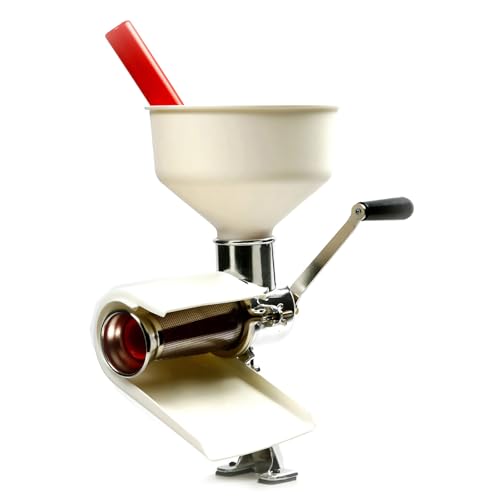
- 3-quart capacity
- Separates juice and pulp in one operation
- Supports optional specialty screens
Best For: Multi-purpose sauce, puree, fruit, and vegetable preparation
Simple Suction-Mount Pick

- Separates skins and seeds from juice
- Uses a sturdy suction-cup base
- Includes stainless steel pusher
Best For: Small-batch sauces, salsa, juice, and tomato purees
Manual Multi-Use Pick
Stainless Steel Food Mill with 3 Discs

- Includes three interchangeable milling discs
- Stainless steel body with silicone grips
- Works for sauces, jams, and mashed foods
Best For: Manual texture control across tomatoes, fruits, and vegetables
Best Manual Pick
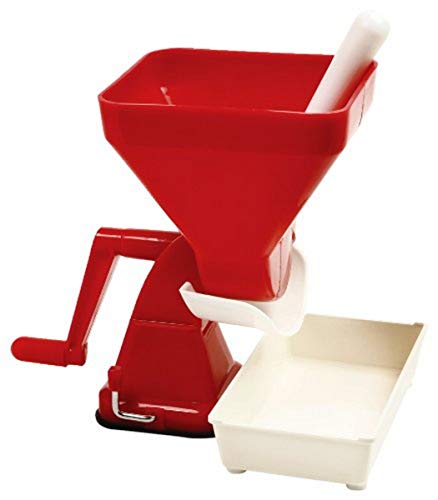
- 2.25-quart hopper for larger batches
- Stainless mesh separates skins and seeds
- Includes tray, pestle, and recipes
Best For: Home canners who prefer manual processing
Best Large-Hopper Option
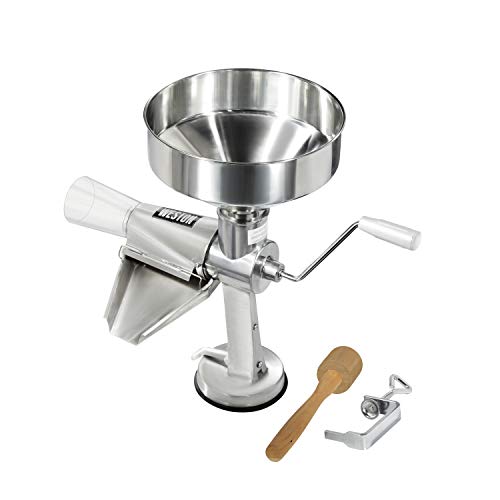
- One-gallon stainless steel hopper
- Suction-cup and C-clamp mounting
- Includes stomper and 1.5mm screen
Best For: Large-batch sauce and preserve making
Best Electric Choice
VEVOR Electric Tomato Strainer

- Motorized processing for continuous use
- Four screens for different textures
- 304 stainless steel construction
Best For: Large-batch and harvest-season canning
Simple Manual Pick
Compact Tomato Juicer Sauce Maker

- Stainless steel filter separates skins and seeds
- Large feed inlet for easier loading
- Manual, energy-saving design
Best For: Home cooks making smaller batches of tomato juice or sauce
Versatile Electric Choice

- 250-watt motor with forward and reverse speeds
- One-gallon hopper for larger batches
- Includes three stainless steel screens
Best For: Home preserving, sauces, salsa, purees, and jams
High-Volume Workhorse
VBENLEM Commercial Tomato Strainer
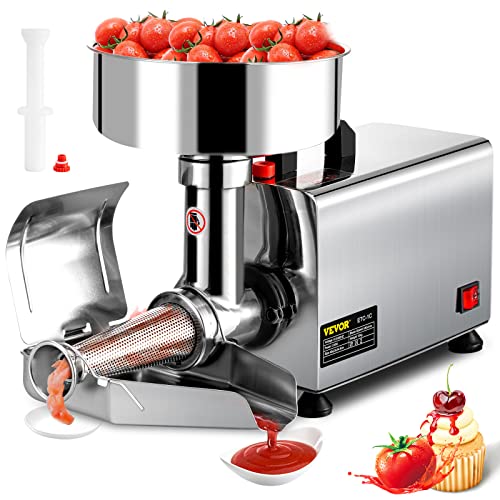
- 370-watt pure copper motor
- 304 stainless steel food-contact parts
- Large 9-inch funnel and adjustable trough
Best For: High-volume sauce, ketchup, and jam processing
High-Volume Electric Pick – OMRA Spremy Electric Tomato Strainer
For shoppers comparing tomato presses, the OMRA Spremy stands out as a high-capacity electric option. Its 1/4 HP motor and masticating-style worm are designed to process fresh or cooked tomatoes while separating skins and seeds from puree.
Best For: Gardeners and home cooks processing large tomato harvests with minimal manual effort.
Pros:
- Processes up to 330 pounds of tomatoes per hour.
- Automatically separates puree from seeds and skins.
- Die-cast metal housing, stainless steel hopper, and food-grade nylon auger.
- Made in Italy with a cooling-fan-equipped motor.
Cons:
- Requires corded electric power and is listed at 220 volts.
- Its high-throughput design may be more than occasional users need.
The OMRA is the strongest fit when speed and volume matter most. Confirm the electrical requirements before buying, especially for use in a standard home kitchen.
Versatile Sauce-Making Pick – Norpro 1951 Sauce Master
The Norpro 1951 is a versatile manual-style option among tomato presses, using a chrome-plated steel screen to separate juice and pulp in one operation. Its 3-quart capacity and included fine mesh screen make it suitable for sauces, purees, and other prepared foods.
Best For: Cooks who want one strainer for tomatoes, vegetables, fruits, and purees.
Pros:
- 3-quart, or 95-ounce, capacity.
- Automatically separates juice and pulp.
- Includes a fine mesh screen, standard spiral, recipes, and instructions.
- Additional berry, pumpkin, and salsa screens are available separately.
Cons:
- Extra screens are not included.
- The supplied dimensions indicate a relatively large footprint.
The Sauce Master is a practical choice if you want broader food-processing flexibility rather than a tomato-only tool. Its expandability is useful for cooks who regularly make different types of sauces and purees.
Simple Suction-Mount Pick – Tomato Strainer and Food Mill
This tomato strainer is a straightforward choice for shoppers seeking tomato presses for homemade sauces and salsa. It uses a suction-mounted base, a stainless steel pusher, and a side-ejection design that directs skins and seeds away from the juice.
Best For: Home cooks making tomato juice, purees, salsa, and pasta sauces in smaller batches.
Pros:
- Separates skins and seeds while juice flows into the tray.
- Sturdy suction mount helps hold the mill in place.
- Includes a stainless steel pusher.
- Designed for straining, juicing, and pureeing tomatoes.
Cons:
- Plastic construction may feel less substantial than metal alternatives.
- Manual operation requires active feeding and turning.
Choose this model for accessible, hands-on tomato processing without peeling, coring, or deseeding first. The suction base and compact listed dimensions make it a useful fit for routine kitchen projects.
Manual Multi-Use Pick – Stainless Steel Food Mill with 3 Discs
For a manual alternative among tomato presses, this stainless steel food mill offers three milling discs for different textures. Its dual-hook design, silicone-covered handles, and included spoon support steady grinding of tomato sauce, fruits, vegetables, jams, and mashed potatoes.
Best For: Cooks who want one manual mill for tomatoes and a range of soft foods.
Pros:
- Includes three milling discs with different pore sizes.
- Food-grade stainless steel construction with a polished surface.
- Dual hooks form a stable triangle with the handle for bowl support.
- Silicone grips improve comfort and non-slip handling; included spoon helps press and scrape food.
Cons:
- Manual cranking is less convenient than an electric strainer for large batches.
- Its broader food-mill design may not separate tomato processing as quickly as a dedicated strainer.
This mill is a flexible choice when texture control and multi-purpose use are more important than maximum throughput. The interchangeable discs make it especially useful for cooks preparing both tomato sauces and other purees.
Best Manual Pick – Norpro Jumbo Tomato Strainer
If you want straightforward tomato presses for homemade marinara, salsa, juice, or puree, the Norpro Manual Jumbo Tomato Strainer offers a practical hand-crank design. Its stainless steel mesh separates seeds, skins, and stems, while the suction base helps keep it steady on smooth work surfaces.
Best For: Home canners and cooks processing moderate-to-large batches manually.
Pros:
- 2.25-quart hopper supports larger batches.
- Stainless steel mesh automatically separates seeds, skins, and stems.
- Includes a receiving tray, pestle, instructions, and starter recipes.
- Also works for cooked applesauce.
Cons:
- Manual cranking requires more effort than an electric model.
- Suction base is intended for smooth countertops, tables, or islands.
The Norpro is a versatile choice when you value manual control, included accessories, and a relatively large hopper for seasonal sauce preparation.
Best Large-Hopper Option – Weston Metal Tomato Strainer
Among tomato presses for bigger harvests, the Weston Metal Tomato Strainer stands out with its one-gallon hopper and smooth manual operation. The dual-mount system can attach with either a suction cup or C-clamp, giving you more flexibility when choosing a work surface.
Best For: Large-batch sauce, puree, jam, and preserve preparation.
Pros:
- One-gallon stainless steel hopper handles substantial batches.
- Dual mounting system works with a suction cup or C-clamp.
- Includes a stomper and 1.5mm multipurpose screen.
- Splash guard and directed chute help reduce mess.
Cons:
- Additional screens are sold separately.
- Manual operation still requires hand cranking.
Choose the Weston if capacity and mounting flexibility are priorities. Its included screen covers common tomato and apple preparations, while optional screens expand its versatility.
Best Electric Choice – VEVOR Electric Tomato Strainer
For shoppers comparing electric tomato presses, the VEVOR model uses a motorized system to separate peels and seeds without hand cranking. It includes four screens for different textures and is designed for continuous sauce making, puree preparation, and larger canning sessions.
Best For: Users who want powered processing for repeated or large-batch sauce making.
Pros:
- Electric motor provides steady power for continuous processing.
- Includes 1mm, 1.5mm, 3mm, and 6mm screens.
- 304 stainless steel parts resist fruit acids and wear.
- Guard cover helps reduce splatter.
Cons:
- Requires access to electrical power.
- Weighs 7.2 pounds, making it less lightweight than basic manual presses.
- Powered operation may be more equipment than occasional users need.
The VEVOR is the most suitable option here for sustained processing and texture experimentation. Its multiple screens and motorized operation make it particularly useful during harvest-season canning.
Simple Manual Pick – Compact Tomato Juicer Sauce Maker
This manual tomato press is a straightforward option for separating tomato skins and seeds from pulp without relying on electricity. Its stainless steel filter, large feed inlet, and simple construction make it practical for everyday sauce and juice preparation.
Best For: Home cooks who want an energy-saving manual tomato press for smaller batches of sauces or juices.
Pros:
- Stainless steel filter separates peels and seeds from pulp.
- Large-capacity feed inlet helps accommodate more produce at once.
- Simple structure is designed for convenient cleaning and high juice yield.
- Wear-resistant PP shell is built for regular kitchen use.
Cons:
- Manual operation requires more effort than an electric tomato press.
- Supplied notes do not specify a batch capacity or included accessories.
Choose this model if you value a basic, adjustable tomato press with no motor or power connection. It is best suited to users who prioritize simplicity and energy savings over high-volume processing.
Versatile Electric Choice – Weston Deluxe Tomato Strainer
The Weston Deluxe is a versatile electric tomato press for processing tomatoes, soft fruits, and vegetables into sauces, purees, jellies, or salsa. Its 250-watt motor, two-speed operation, one-gallon hopper, and three screens support both everyday cooking and preserving larger harvests.
Best For: Home preservers who need an electric tomato press for flexible recipes and larger batches.
Pros:
- 250-watt motor offers forward and reverse speeds to help prevent jamming.
- One-gallon hopper supports larger batches without frequent refilling.
- Three stainless steel screens handle fine straining, larger vegetables, and chunky mixtures.
- Removes skins and separates seeds without requiring tomatoes to be cored first.
Cons:
- Requires access to a 120-volt AC power source.
- Larger 14-by-12-by-17-inch footprint may require dedicated storage space.
With its screen selection and reverse function, this Weston tomato press offers more control than a basic single-purpose strainer. It is a strong fit for cooks who regularly make sauces, salsa, jams, or preserved produce.
High-Volume Workhorse – VBENLEM Commercial Tomato Strainer
The VBENLEM tomato press is designed for high-volume processing, combining a 370-watt pure copper motor with a large 9-inch funnel and stainless steel food-contact components. Its adjustable trough and claimed 90–160 kg/h processing range make it suited to demanding sauce-making tasks.
Best For: Users processing substantial quantities of tomatoes and other fruit for sauces, ketchup, or jams.
Pros:
- 370-watt pure copper motor supports heavy-duty processing.
- Food-contact parts use 304 stainless steel and the unit is designed for disassembly and cleaning.
- Large 9-inch funnel helps feed fruit efficiently.
- Adjustable trough and brace help direct sauce and reduce splashing.
Cons:
- At 22 pounds, it is substantially heavier than a compact kitchen press.
- Requires a 110-volt AC power connection.
- Its commercial-grade size may be excessive for occasional small batches.
This VBENLEM tomato press is the most production-oriented option in the group. Its motor, stainless steel construction, and large feed design favor throughput and durability, while the larger footprint and weight make it better for a dedicated workspace.
How We Picked These Tomato Presses
We selected models across the main categories shoppers consider: manual tomato strainers, rotary food mills, countertop electric machines, and higher-capacity commercial-style presses. Our comparison emphasizes the features that affect real preparation work, including motor or crank performance, hopper size, material quality, separation efficiency, stability, and cleanup.
We also considered whether each design suits occasional sauce making, frequent garden harvests, or larger canning sessions. Product specifications can vary by seller, so confirm current dimensions, voltage, included screens, and stated capacity before ordering.
Quick Comparison
| Best For | Recommended Type | What to Look For |
|---|---|---|
| Occasional small batches | Manual strainer or food mill | Comfortable handle, stable base, easy cleaning |
| Regular home sauce making | Electric tomato strainer | Reliable motor, sturdy hopper, replacement parts |
| Large harvests and canning | High-capacity electric press | Metal construction, continuous processing, strong output |
| Multiple foods | Food mill with interchangeable discs | Several screen sizes and versatile processing options |
Key Buying Factors for Tomato Presses
Manual or Electric Operation
Manual models are generally quieter, simpler, and easier to store. They work well for smaller batches and avoid motor or voltage concerns, but processing requires steady cranking. Electric Tomato Presses are faster and reduce physical effort, making them more useful when handling bushels of tomatoes.
Capacity and Output
Check the hopper size and the manufacturer’s stated processing rate, but treat maximum figures as ideal-condition estimates. A larger hopper and continuous-feed design can save time during canning, while a compact machine may be more convenient for everyday portions.
Materials and Stability
Stainless steel and durable metal components typically withstand frequent use better than lightweight plastic parts. A secure clamp, broad base, or non-slip feet matter because pressing tomatoes creates steady force and vibration.
Separation and Cleanup
Look for an adjustable or appropriately sized screen that separates skins and seeds without clogging. Removable screens and food-contact parts make rinsing easier. Verify whether components are dishwasher-safe and whether replacement screens, augers, or gaskets are available.
Power and Compatibility
For electric models, confirm voltage, wattage, plug type, and intended duty cycle. Higher wattage does not automatically mean better performance, so also consider cooling, construction, and the maker’s recommended operating limits.
Who Should Buy Which Tomato Presses?
Choose a manual press if you make sauce only occasionally, want a low-cost tool, or prefer equipment that stores easily. A rotary food mill is the most versatile choice when you also process potatoes, jams, purées, or soups.
Choose a standard electric strainer if you make sauce regularly and want a balance of speed, convenience, and manageable size. For large gardens, frequent canning, or commercial-style workloads, prioritize a heavy-duty electric model with a metal body, generous hopper, and clearly supported replacement parts.
Whichever model you choose, soften tomatoes first when required by the instructions, feed produce gradually, and clean the screen and auger promptly after use. Those simple steps help maintain consistent sauce texture and extend the press’s useful life.